LinkedIn AI Visibility: How to Get Your Content Cited by AI Search
To get your LinkedIn content cited by AI, publish under your own name, open every text with the answer and write paragraphs that make sense on their own. Those are the only recommendations from LinkedIn's official AI visibility guide that held up in Surfer's data or in my own measurement. The rest is LinkedIn marketing, but I have a few tips on what works.

Rafal Szymanski
I implement LinkedIn and Sales Navigator in companies so they turn a profit.
I've been training people in LinkedIn since 2016 — more than 3,700 of them, across 80+ B2B companies. Founder of B2B Marketing.AI, a CRM platform for advanced LinkedIn users. I help sales and marketing teams turn LinkedIn into a predictable source of leads. I've spoken about LinkedIn at the biggest conferences, including I Love Marketing, InfoShare and Effie, and picked up a few awards along the way.
Published On
In this article you’ll find an analysis of LinkedIn’s guide to AI visibility (“Unlocking AI Search Visibility”, 36 pages, 2026): which recommendations are backed by data, which clash with other research, and which mainly serve LinkedIn by driving more content onto the platform. I compare it with Surfer’s data from a Linkhouse webinar and with my own measurements (in B2B Marketing.AI) of what ChatGPT, Gemini and Perplexity answer when asked about LinkedIn trainers and consultants. By LinkedIn AI visibility I mean two things: whether an AI model mentions you by name in its answer, and whether it links to your website or profile.
Although I write here mostly about LinkedIn and AI, my company works on everything that supports B2B sales, so we also build our own SEO tools, and since early 2026 tools for AEO and GEO as well.
On October 13 and 17, 2026, I asked three AI models 14 questions such as “Who runs LinkedIn training for companies in Poland?”, five times each. The questions were in Polish, because that is my home market. Each run produced 210 answers, and the second one 4,031 sources. Almost one in three (30.4%) pointed to linkedin.com. With Gemini, however, only 5 of 549 sources led to LinkedIn, and in the first run 1 of 527. The numbers in this article come from the second run unless I say otherwise.
So is LinkedIn right when it calls itself the most cited domain for professional queries? Partly.
In this article you'll learn:
- whether LinkedIn is the most cited source in AI answers, and in which AI models;
- whose content AI cites more often: personal profiles or company pages;
- whether a LinkedIn article beats a post (in my data, it doesn’t);
- how to structure a text so it can be cited;
- how long to wait for the first citation and how not to misread the results;
- the five places where LinkedIn’s guide clashes with Surfer’s data.
How do you get your LinkedIn content cited by AI? The short version
Publish under your own name, open every text and every section with an answer of 30–80 words, and write paragraphs that make sense without their neighbors. That much from LinkedIn’s guide held up outside it. The other recommendations are disputed or have no data behind them, so test them on your own questions and judge results after 30 days at the earliest.
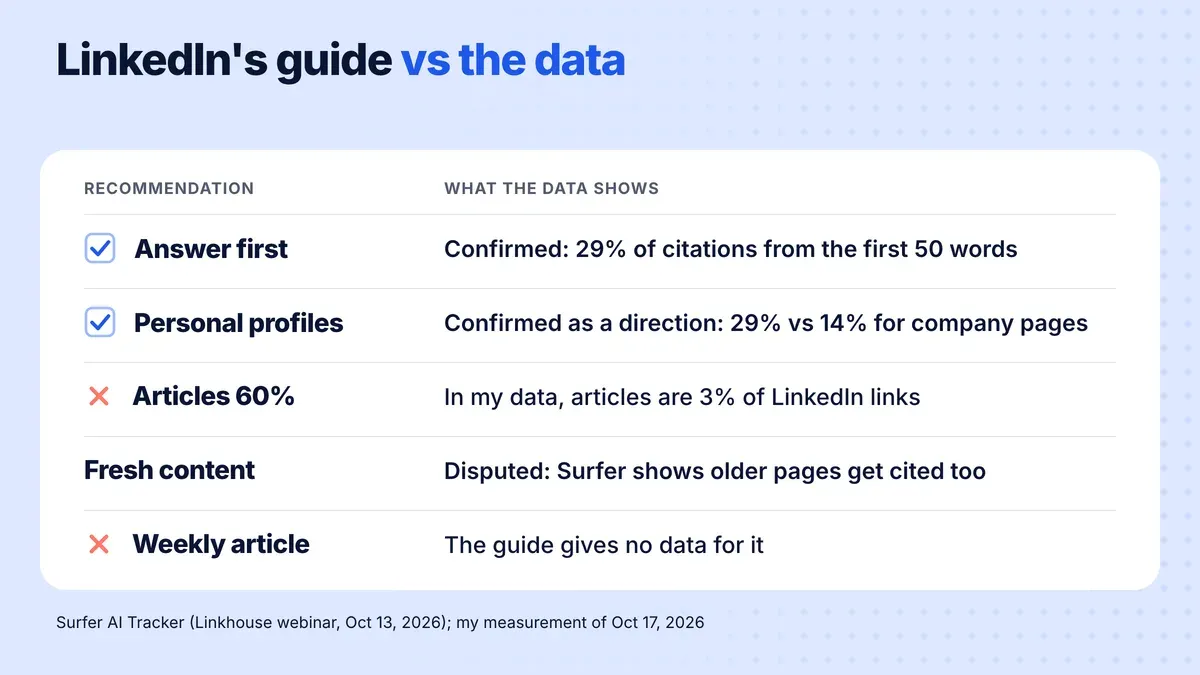
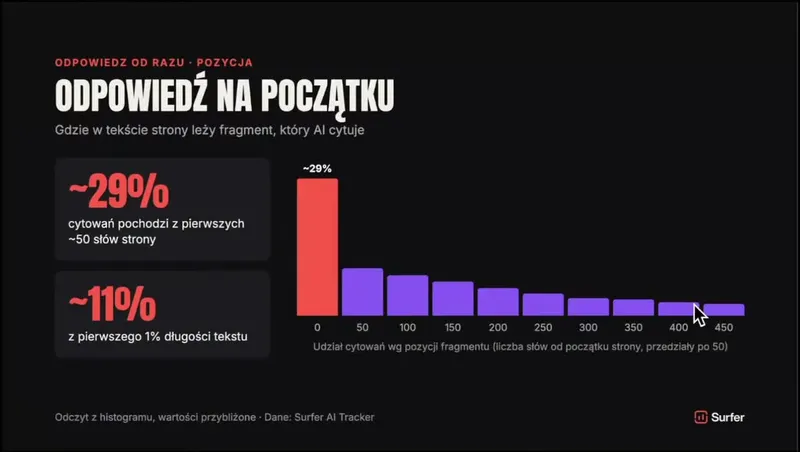
- confirmed: the answer at the very start (the guide, p. 25; in Surfer’s data about 29% of citations come from the first 50 words of a page);
- confirmed in my data as a direction: personal profiles are cited more often than company pages (the guide: 75% to 25%, my measurement: 29.2% to 14.1%);
- not confirmed in my data: “articles 60%, posts 40%”, because in my questions articles were 2.9% of links to linkedin.com, though I explain later why that may be;
- disputed: content freshness, a summary at the end and numbers in the text;
- no data in the guide itself: an article every week and posts 2–3 times a week.
What is LinkedIn’s AI visibility guide, and where do its numbers come from?
It’s a 36-page PDF, “Unlocking AI Search Visibility: The B2B Marketer’s Guide to LinkedIn”, published by LinkedIn in 2026. Most of its numbers come from three companies that sell AI visibility tracking tools (Profound, Meltwater and Semrush), and some from LinkedIn’s internal data, given without any description of the method. That’s why I treat these numbers with a good deal of suspicion.
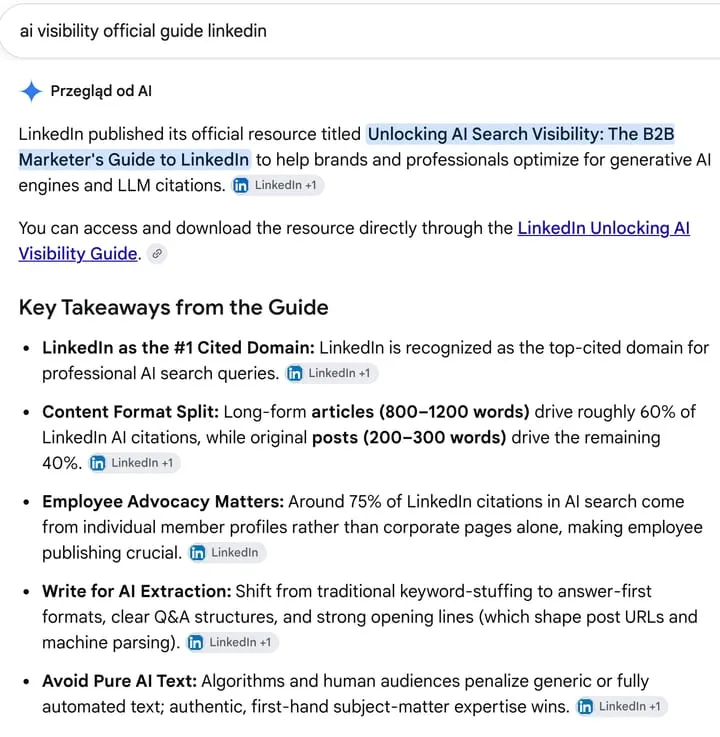
LinkedIn’s guide tells you to publish on LinkedIn. No surprise there, because it struggles to get people to write on it. Its own data says only 1–2% of users actively post. That’s why I give the page and the company behind every number, because “LinkedIn internal data” and “Meltwater analysis” are self-reported, and I like certainty. Google showed me I’m not being paranoid: its AI Overview summarized this very guide, got two numbers wrong and added a breakdown that isn’t in the guide. So AI misread an AI guide about AI visibility. Somehow that doesn’t surprise me :)
What did it get wrong? On October 13 it said LinkedIn accounts for “about 60% of citations”, while in the guide 60% is the share of articles among citations of LinkedIn content (pp. 16–18). It also gave a threshold of “over 3,000 followers”, although the guide says 2,000 (p. 21), and 3,000 is the character limit for a post (p. 17). On top of that, it added three “layers of visibility” that aren’t in the guide. I didn’t take a screenshot then, and four days later the same query got the numbers right, but this time AI Overview presented advice with no data behind it, such as posting 2–3 times a week, as what “AI models look for”. The query “ai visibility official guide linkedin” produced yet another version: under the heading “Employee Advocacy Matters”, the 75% of citations that come from personal profiles became an argument for employee posting. The guide doesn’t use that term and doesn’t connect the two: it covers personal profiles on page 9 and employee activity on pages 14–15. Part of the confusion starts with LinkedIn itself: its blog says that articles, newsletters and posts together account for 60% of all citations. That’s why I check any number from an AI answer against the document before I repeat it.
The guide itself warns that it’s no recipe for success. Page 15 says “following these steps won’t, on its own, get you cited by LLMs”, and on page 33 Cassie Dell, Head of Organic Growth at LinkedIn, writes: “Don’t fall for universal ‘best practices’. What works for one brand might not work for yours”. I’m taking her at her word and checking.
What do I compare the guide with?
- Surfer AI Tracker data that Michał Suski (Surfer) showed at a Linkhouse webinar on October 13, 2026, and slides by Szymon Słowik (Takaoto) from the same webinar. Surfer also sells a tracking tool, so this author has an interest too;
- an internal presentation and consultations with Mike Korba of Positive, the company that owns Surfer among others. Mike prepared several LinkedIn analyses especially for me, covering about 20,000 citations in AI answers in total, and I’m very grateful to him for that;
- a measurement in HubSpot AEO on my account: 10 questions about LinkedIn consultants and agencies, 870 answers from ChatGPT, Gemini and Perplexity, from July 28 to August 26, 2026. HubSpot generated the questions when I set up the account, and they are about agencies, not trainers;
- my own October 2026 measurements: 14 questions about LinkedIn and Sales Navigator trainers, three AI models queried through the API with web search, 5 repetitions, 210 answers per run (3,340 sources on October 13 and 4,031 on October 17). I repeat the measurement every week, without Copilot and without AI Overviews, because they have no API you can query.
In this article a citation is a link in an answer’s list of sources, and a mention is a name or brand in the answer’s text.
Is LinkedIn really the most cited source in AI search?
For questions about whom to hire for LinkedIn, yes: in both of my measurements linkedin.com is about a third of all sources (33% in HubSpot and 30.4% in the October measurement). The guide cites Profound (2026, p. 9), according to which LinkedIn is the most cited domain for professional queries. The exception is Gemini, which barely cites LinkedIn at all.
In HubSpot, linkedin.com collected 2,183 of 6,582 citations and was the top domain on the list. And my own website? 118 citations (1.8%), sixth place.
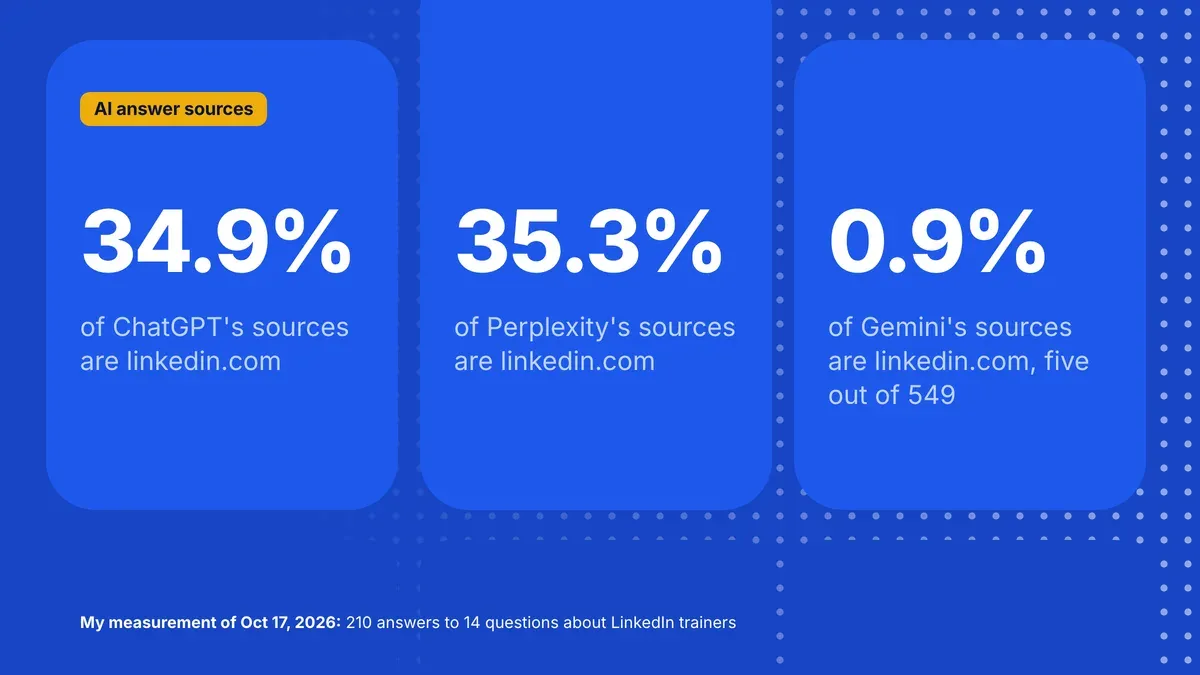
And what does the October measurement look like split by AI model? ChatGPT takes 34.9% of its sources from linkedin.com (848 of 2,432), Perplexity 35.3% (371 of 1,050), and Gemini 0.9%, the five sources out of 549 I mentioned. On the other hand, 26.6% of Gemini’s sources are my own website, the same in both runs. Why does Gemini skip LinkedIn? I don’t know, and the guide doesn’t split its numbers by model, so it doesn’t answer either. My hypothesis is that ChatGPT relies on Microsoft’s data: it takes it from Bing and has direct access to LinkedIn data, because Microsoft owns LinkedIn and is a major shareholder in OpenAI. Google has no such access.
Even in the guide itself, first place is not the rule. The table on page 10, with Meltwater data, puts LinkedIn first in “Marketing & Advertising”, second in “Sales & Revenue”, fourth in “Healthcare & Life Sciences” and fifth in “Energy & Sustainability”.
And Surfer? On the slide at 26:12, social media content correlates with citation frequency at 0.12, while brand blogs reach 0.35.
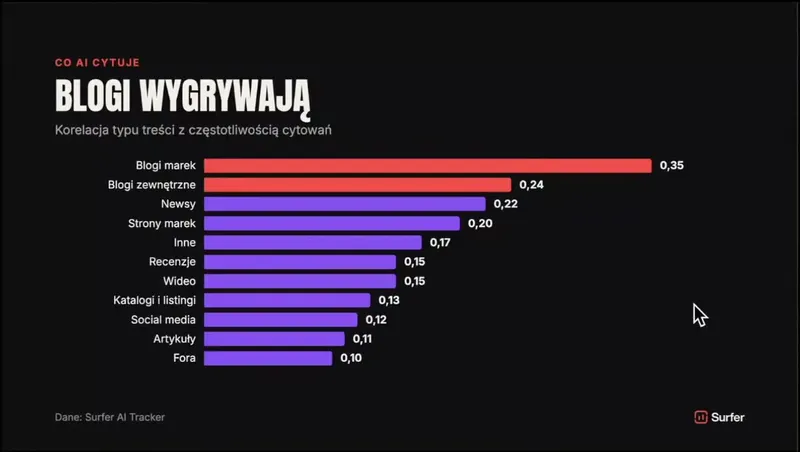
That doesn’t have to contradict Profound, because Surfer counts all topics and content types, and Profound only professional queries. My takeaway is that LinkedIn won’t replace your own website: in my measurement rafalszymanski.pl is 14.3% of all sources, and LinkedIn 30.4%.
Do personal LinkedIn profiles or company pages perform better in AI search?
Personal profiles, more often. According to Meltwater, which the guide cites (p. 9), 75% of citations of LinkedIn content come from personal profiles and 25% from company pages. In my data, other people’s profiles are 29.2% of links to linkedin.com and company pages 14.1%: the same direction, with a smaller lead.
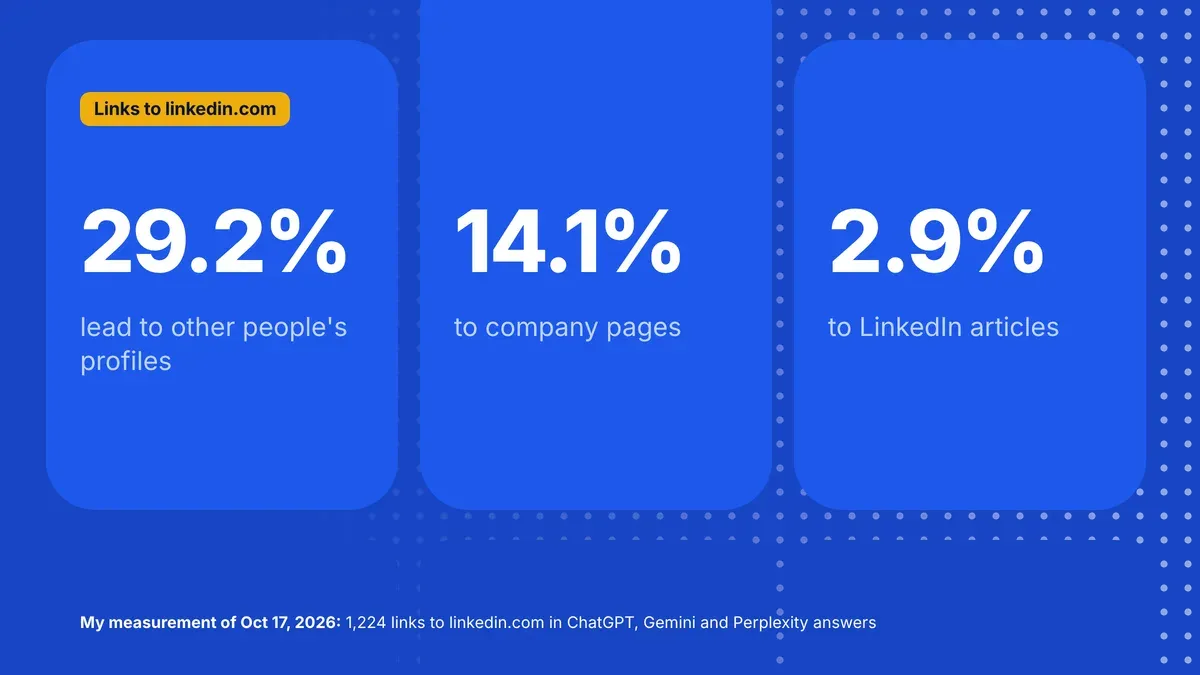
The guide splits those 75% into two groups: 40% are people with more than 10,000 followers, and 35% are people below that threshold who post regularly. CEOs account for 8.2% of cited content and founders for 7.5%, and according to Meltwater the job title matters less than the area of expertise. Two more numbers from this part: authors with at least 2,000 followers are cited more often, although there’s no “magic number” (Meltwater, 2026, p. 21), and 95% of citations are of original posts, not reshares (Semrush, 2026, p. 21).
This is what the 1,224 links to linkedin.com from the second run look like:
| Type of linkedin.com URL | Share |
|---|---|
other people’s profiles (/in/) | 29.2% |
company pages (/company/) | 14.1% |
| my profile, my company page and my posts | 9.3% |
other people’s posts (/posts/) | 10.9% |
articles (/pulse/) | 2.9% |
| other URLs, including the people directory | 33.7% |
Can these numbers be compared one to one with Meltwater? No. Meltwater splits citations by account type and I split them by URL type, and on top of that my questions are of the “who trains” kind, so they lead to people by design.
One thing made me laugh. In 12 of 15 answers to questions with my name in them, ChatGPT added to its sources the profiles of other people called Rafał Szymański (greetings to my namesakes). Across the whole measurement there were 14 such URLs.
The lesson? For AI to cite you, it has to be sure that you really are you, not someone else with the same name. That’s what the Person markup from schema.org on your website is for, with links to your LinkedIn profile and your other accounts inside it.
Szymon Słowik also suggested saying on your website who you are not. So I’ll add to mine that I’m the Rafał Szymański of LinkedIn and community work, not the commander of the Dar Młodzieży tall ship, a police officer, a psychiatrist from Poznań or the creator of LEGO brick exhibitions.
Articles or posts: what LinkedIn content is most likely to be cited by AI tools?
The guide bets on articles: according to LinkedIn’s internal data, they account for about 60% of citations of content from the platform and posts for about 40% (pp. 16–18). My measurement doesn’t show that: articles were 2.9% of links to linkedin.com and posts 10.9%. It may come down to the questions: mine are about who trains, and questions like that lead to profiles.
In my view the reason is even simpler: neither I nor most of the people I monitor publish articles on LinkedIn. I don’t have an article about my own services either, so the models had nothing to cite.
Does a polished article guarantee anything? No. My client Monika Pakulska runs the LinkedIn newsletter LeadMeNot by Monika & Pat: 13 editions, 2,274 subscribers, each one written to SEO best practice. It should show up in Google and in AI answers, and it doesn’t. Ordinary posts, less polished than articles, on the other hand, show up quite well in both Google and AI.
What does the guide recommend for each format?
- article: 800–1,200 words (pp. 18 and 23), with the caveat that there’s no ideal length. The summary on page 35 of the same guide says 800–2,500 words, so it contradicts itself a little;
- post: 200–300 words (pp. 18 and 23), with a limit of 3,000 characters (p. 17);
- an article’s title becomes its URL, and the first sentence of a post often ends up in its URL and can’t be changed after publishing. Hence the advice not to start with emoji or hashtags (p. 23);
- one article, then 3–5 posts, each taking a single idea from it (p. 24);
- a newsletter or a single article: according to the guide, AI models don’t tell them apart (p. 13).
I have examples of my own. The URL of one of my posts is rafalszymanski_linkedin-salesnavigator-activity-…: nothing but hashtags, not a word about what the post says. Another starts with aaaaa-jaram-się-ai (Polish for “aaaaa, I’m excited about AI”). And yet ChatGPT cited the first one in my measurement, in an answer about reviews of my training.
Does the main piece have to be a LinkedIn article? No. On page 17 the guide says posts point to a fuller main piece and gives a LinkedIn article or a blog post as examples of such a piece. In other words, the main piece can live on your own website, which matches Surfer’s data on brand blogs.
How do you structure a text so AI can cite it?
Start with the answer. The guide recommends a 30–80-word block at the start of every major section (p. 25) and subheadings phrased as questions (p. 19). This recommendation has the strongest support outside the guide: in Surfer’s data, about 29% of citations come from the first 50 words of a page (slide at 30:06).
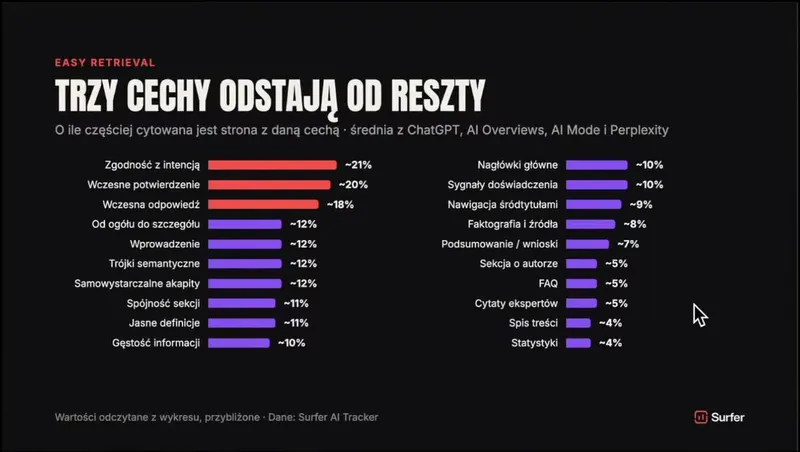
In Surfer’s data, three page features stand out from the other seventeen, and all of them are about how the text begins. A page that matches the intent of the user’s question is cited about 21% more often, a page whose first sentences confirm the topic about 20% more often, and a page with the answer right at the start about 18% more often (slide at 27:32, values read off the chart). Paragraphs that make sense without the rest of the text add about 12%.
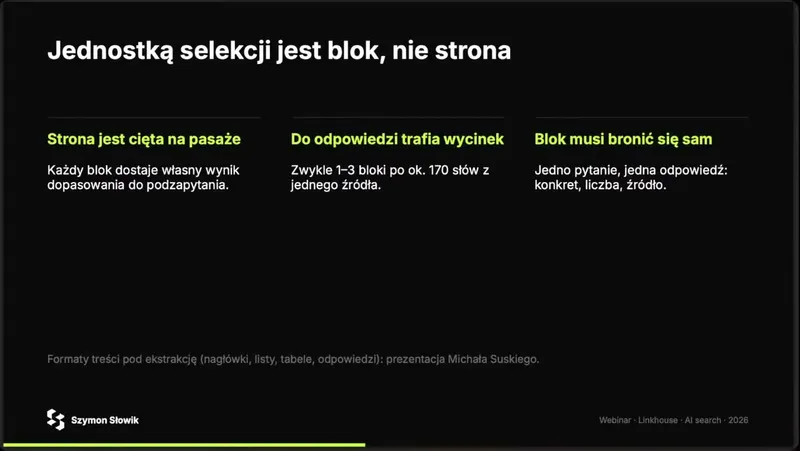
Szymon Słowik showed where this comes from: an AI model doesn’t pick a page, it picks a block of text, and an answer usually takes 1–3 blocks of about 170 words each from a single source (slide at 1:06:07).
The rest of the guide’s recommendations are about the skeleton of an article (pp. 19 and 23):
- a summary at the top, the TL;DR;
- subheadings phrased as questions, answered in one or two sentences;
- lists and simple definitions;
- a summary or checklist at the end;
- a short author bio.
The guide also shows what the 24 most cited LinkedIn articles have in common (Meltwater, 2026, p. 20): 100% of them have lists, 92% use H2 and H3 subheadings, 75% name companies and tools, 67% contain hard numbers, 50% are X vs. Y comparisons, 33% are “how to choose” guides, and 25% have the year in the title. Does that mean a list raises your chances of being cited? This sample can’t tell, because it has no control group. We don’t know how many articles with lists nobody ever cited.
This article follows those recommendations, so I also checked my older ones. In 29 of my 45 posts the intro before the first subheading runs over 150 words, and only 15 have questions as at least half of their subheadings. I have some rewriting to do.
How long does it take for AI to cite new content?
The guide says to wait at least 30 days before judging the results (p. 28). It cites Profound: among about 900 new pages that ChatGPT or Claude cited between March and May 2026, half got their first citation 6.81 days after publication, 75% within 18.68 days and 90% within 37.10 days.
Does that mean nine out of ten new texts will be cited in under six weeks? No. Profound’s sample only includes pages that were cited within 60 days. Nobody counted the ones the models never cited.
The guide gives three reasons for the delay (p. 28): search indexes refresh at their own pace, AI models need several sources that agree, and each model updates separately, so visibility changes in jumps. It also warns against declaring failure in week three.
This is how it looks for me: I run two baseline measurements a few days apart to learn how much normal noise there is between runs. The first was on October 13, before consistent facts about me went live on my website. The second was on October 17, after that change. The result? My numbers moved within the noise, so I don’t credit the difference to the changes on my site. Only one competitor grew clearly beyond the noise, a professional training company on my list: it appeared in 72 of 165 answers instead of 46, so they’re probably paying attention to this too. From now on it’s the same 14 questions every week, and I’ll judge the effect no earlier than November 12, 30 days after the changes. I also measure markets separately, because the same topic in Polish and in English has a different person asking and a different goal.
Where does LinkedIn’s guide disagree with other data?
In five places: content freshness, a summary at the end of the text, numbers in the text, the role of social media, and how to check whether AI can access your page. In each of them, the other side is Surfer AI Tracker data or Szymon Słowik’s slides from the Linkhouse webinar on October 13, 2026.
| Topic | LinkedIn’s guide | Linkhouse webinar |
|---|---|---|
| Content freshness | 48% of citations go to content less than 3 months old, 12% to content older than a year (Meltwater, 2026, p. 22) | outside Gemini, 57–74% of citations go to pages older than six months (Surfer, slide at 39:59) |
| Summary at the end | AI models “often pull” closing lists into answers, without any number (p. 19) | a page with a summary is cited about 7% more often, in AI Mode about 13%, in Perplexity about 2% (Surfer, slide at 35:25) |
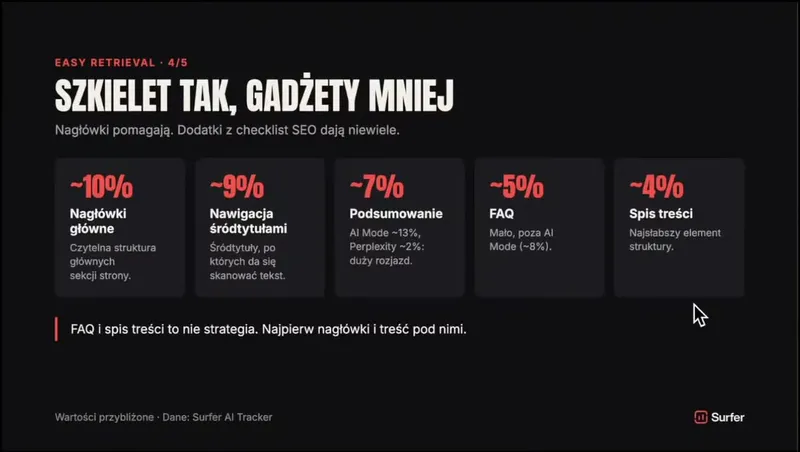
| Numbers in the text | 67% of the 24 most cited articles contain hard numbers (Meltwater, 2026, p. 20) | statistics come last on the list of 20 features, about 4% (Surfer, slide at 36:47) |
| Social media as a source | LinkedIn is the number one domain for professional queries (Profound, 2026, p. 9) | social media content correlates with citation frequency at 0.12, brand blogs at 0.35 (Surfer, slide at 26:12) |
| Access test | “ask AI if it can visit URLs you care about” (p. 22) | “The bot in your session is not the bot that crawls the web” (Słowik, slide at 58:50) |
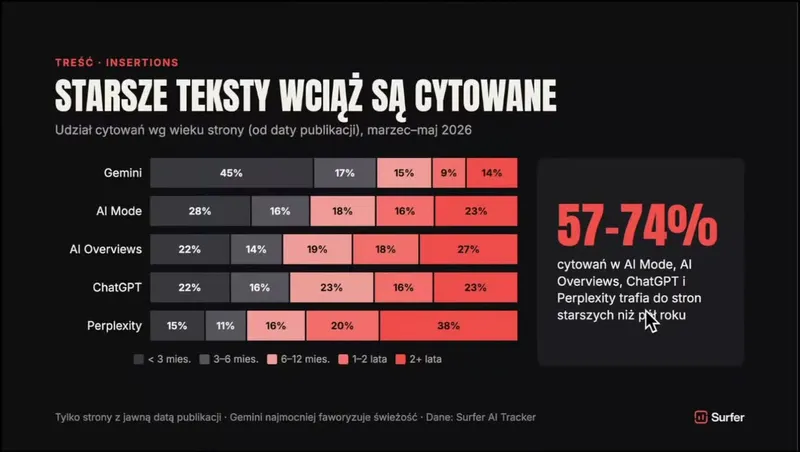
Who’s right about freshness? Possibly both. In Surfer’s data, Gemini takes 45% of its citations from pages less than 3 months old and Perplexity 15%, so the result depends on which model you measure. The guide doesn’t say which models Meltwater counted.
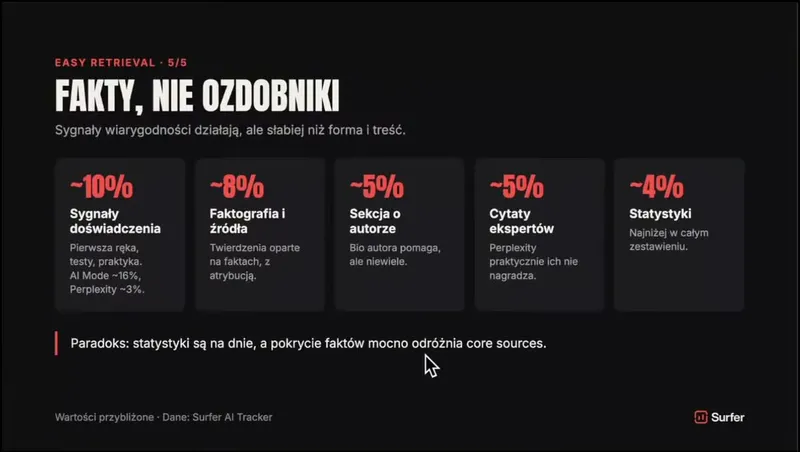
And numbers in the text? Statistics are at the very bottom of Surfer’s list, but pages that are the main source of an answer have a fact-coverage score of 0.42, and pages that were skipped 0.23 (slide at 38:44). So numbers help when they are the facts the answer needs.
Why isn’t the guide’s access test enough? Because OpenAI has separate bots for training AI models (GPTBot), for the ChatGPT search index (OAI-SearchBot) and for fetching a page at a user’s request (ChatGPT-User). When you ask AI in a chat whether it can open your URL, you only test the third one.
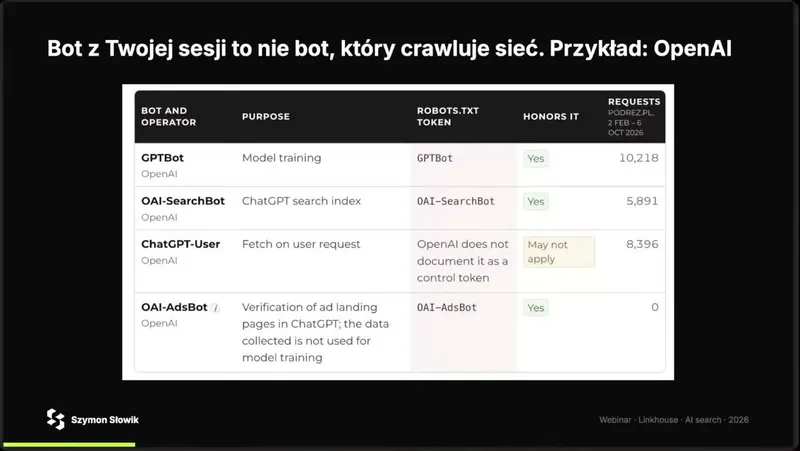
What do they agree on? The answer at the very start, paragraphs that stand on their own, subheadings, and the same facts confirmed in several sources (the guide, p. 12; Słowik, slide at 1:16:08).
Which recommendations mainly serve LinkedIn?
The ones with no number behind them in the guide that increase the amount of content and spending on the platform: an article every week and posts at least 2–3 times a week (p. 22), a newsletter (p. 23), getting employees to post (pp. 14–15) and promoting content with LinkedIn Ads (p. 21).
Is that bad advice? Not necessarily, but the guide shows no data for it, while the benefit to LinkedIn is obvious. The same goes for the advice that a text should have at least ten thoughtful comments under it (p. 21): there’s a number, but no source.
In my view this advice is right, and it also came up in the Social Media Examiner podcast. The catch is that few people without a big team can keep posting that often at a high level. So I’d rather publish less often but better than often and half-heartedly. If I posted just for the sake of it, I’d probably reach for AI, and from there it’s a short step to AI slop.
I wrote about which days to post and how often in my takeaways from the Social Media Examiner podcast on AI on LinkedIn.
How can you measure your LinkedIn AI visibility?
The same way you track rankings in Google, except you type questions instead of keywords. A simple AI visibility audit looks like this for me:
- Write down 7–10 questions your customer would ask, for example “Who runs LinkedIn training for companies in Poland?”. That’s what LinkedIn’s guide recommends (p. 12).
- Ask each one several times in ChatGPT, Gemini and Perplexity, because an AI model’s answers vary between repetitions. I ask each one five times.
- Note two things separately: whether your name or brand comes up (a mention) and whether the list of sources links to your website or profile (a citation).
- Check that your website is in the Google and Bing search indexes, because AI search builds its answers from search results. For several weeks Bing didn’t see my new posts, because I was notifying it about new pages the wrong way.
- Repeat the same set every week and judge the effect after 30 days at the earliest.
Does this replace SEO? No. If a page isn’t in the search results, the model has nothing to cite. Google’s AI Overviews have no API, so for now I check them by hand.
How to improve your AI visibility: what I’m taking from this and what I’ll test next
I’m taking three things: the answer in the first 50 words of every post, subheadings phrased as questions, and the same facts about me everywhere I appear. Will they work? I’ll check with the same measurement.
I had a problem with those facts about me. Until October 13, my homepage said “80+ companies trained”, while the site description and my author bio said “200+”. If I couldn’t make up my mind, how was AI supposed to know? Now the same version is everywhere: 10 years of LinkedIn training, more than 80 companies and more than 3,700 people.
One thing I’m not taking: the idea of dropping SEO and writing only for AI. An AI answer is one of the touchpoints between a customer and you before they ask about your offer, and LinkedIn is just one piece of that puzzle. It’s good that it helps build visibility today, but it needs other channels alongside it. I can see that with Gemini, which barely cites LinkedIn but does cite my website.
I write more about this in Will GEO and AEO replace SEO?.
The next articles in this series will cover whether AI bots visit my website at all, how I rewrote the openings of my posts, how I made my bio consistent, and what the measurement showed after 30 days.
What to check before you publish a LinkedIn article or post
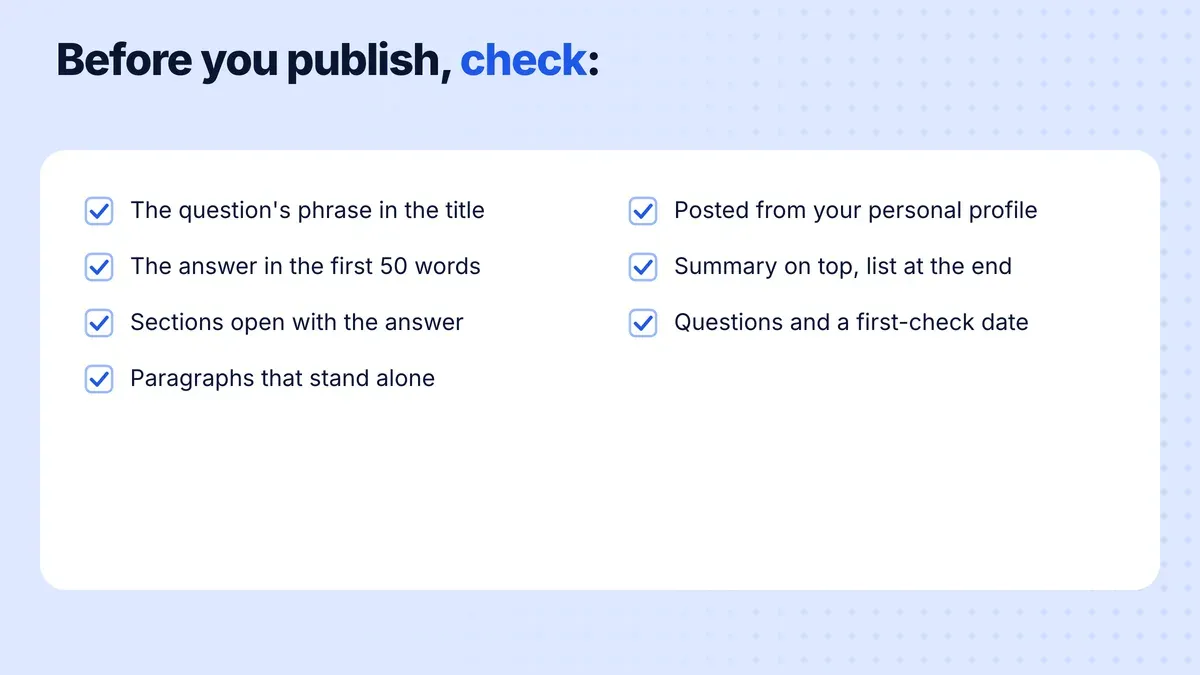
Seven things from the list below. Points two to five are backed outside LinkedIn’s guide, by Surfer’s data or my own measurement. Points one, six and seven are recommendations from the guide (pp. 19, 23, 25 and 28) that I can’t yet confirm or refute.
- The article title or the first sentence of the post contains the phrase a user would type into an AI question, without emoji or hashtags.
- The first 50 words answer the question in the title.
- Every section opens with an answer of 30–80 words.
- Every paragraph makes sense without the ones around it.
- You publish from your personal profile, not only from the company page.
- The article has a summary at the top and a list at the end.
- You have the questions you’ll measure the effect on written down, plus the date of the first check, no earlier than after 30 days.
I run LinkedIn training for companies for a living, so this series is also a test of my own: does what I teach about content work on AI models?
And what do ChatGPT or Perplexity say today when someone asks for the best specialist in your industry?
PS: this article has an FAQ and a table of contents, two items from the very bottom of Surfer’s list (about 5% and 4%). They stay, because people read this too.
PPS: On October 29 I’m opening the I Love Marketing & Technology conference with a talk on AI, AI slop and AI visibility. I’ll show some of this article there live.
FAQ: LinkedIn and AI citations
Maybe we can do something together?
If you like what I write, maybe I can write something for you?