GEO vs SEO: Will GEO and AEO Replace SEO? What My AI Answer Data Shows
No. GEO and AEO won't replace SEO, because an AI answer is one of the touchpoints between a customer and you before they ask about your offer. In my measurement, AI models reached LinkedIn trainers through their own websites almost twice as often as through LinkedIn, and LinkedIn alone was enough in 1 of 165 answers.

Rafal Szymanski
I implement LinkedIn and Sales Navigator in companies so they turn a profit.
I've been training people in LinkedIn since 2016 — more than 3,700 of them, across 80+ B2B companies. Founder of B2B Marketing.AI, a CRM platform for advanced LinkedIn users. I help sales and marketing teams turn LinkedIn into a predictable source of leads. I've spoken about LinkedIn at the biggest conferences, including I Love Marketing, InfoShare and Effie, and picked up a few awards along the way.
Published On
In this article you’ll find my answer to whether, with all the hype around AI visibility, SEO and your own website are still worth the effort, what the difference between GEO and SEO is, and the numbers behind my answer: 165 answers from ChatGPT, Gemini and Perplexity to questions about LinkedIn trainers, LinkedIn’s official AI visibility guide, and two slides from a Linkhouse webinar.
Let’s not get carried away by the hype around AI visibility. I say this as someone who has just measured how often AI recommends him as a LinkedIn trainer, and who intends to improve that result.
In this article you'll learn:
- why I wouldn’t drop SEO for GEO and AEO;
- what the difference between GEO and SEO is;
- where AI models get the pages they cite;
- whether LinkedIn alone can get you into AI answers;
- what LinkedIn’s own guide says about your website.
Will GEO and AEO replace SEO?
In my view, no. An AI answer is one of the touchpoints between a customer and you before they ask about your offer, not the only one, so you can’t drop SEO for GEO or AEO. GEO and AEO are two names for the same thing: the effort to get AI to cite and recommend you in its answers (LinkedIn’s guide uses the abbreviation AEO, p. 3).
An example from my inbox? On October 12 a Polish company that is part of a Norwegian group wrote to me. The manager found me on Google in Polish, went to my website and asked through the contact form whether the training could be in English, because his boss in Norway makes the decision. As the source, he ticked Google search in the form, not a chatbot. His boss will most likely check me out in English as well, on Google or in AI, and that will be one more touchpoint.
What is the difference between GEO and SEO?
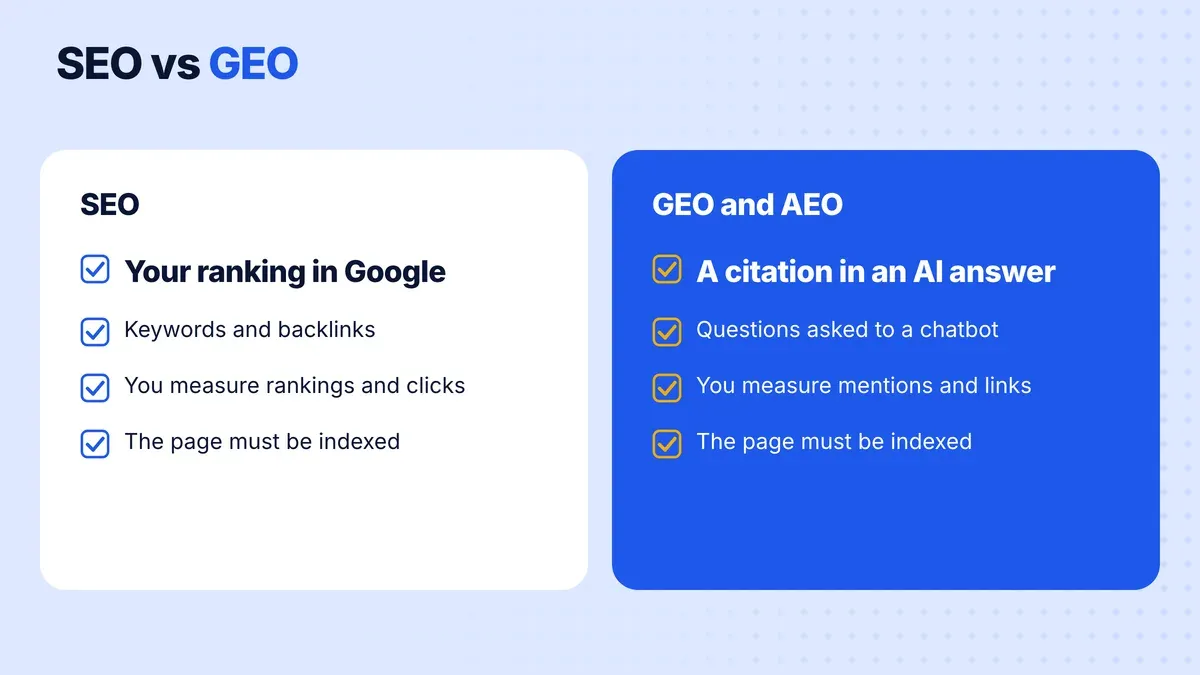
What you compete for. Traditional SEO (search engine optimization) is about ranking pages in search engines: keywords, backlinks and a place on a list of links that users scan and click on their own. GEO (generative engine optimization) and AEO are about optimizing content for AI-driven search: getting large language models (LLMs) like ChatGPT, Gemini or Perplexity to use your content when they synthesize an answer, and to link to it as a source.
SEO and GEO have fewer differences than the hype suggests:
- in SEO, keywords, backlinks and your ranking in Google matter; in GEO, the query a user types into a chatbot and whether the answer mentions your name or links to you;
- in SEO you measure rankings and clicks; in GEO, mentions and citations in answers;
- in both cases your page first has to get into a search engine’s index, because AI models take the content they cite from those indexes. That’s why, for me, a GEO strategy without an SEO strategy doesn’t add up.
Where does AI get the pages it cites?
From search engine indexes. Szymon Słowik (Takaoto) showed this at a Linkhouse webinar on October 13, 2026, on the slide “Indexes: the basis of grounding”: Google, Bing, Brave, Perplexity and OpenAI. For an AI model to cite you, your page first has to get into one of these indexes, and that is plain SEO work.
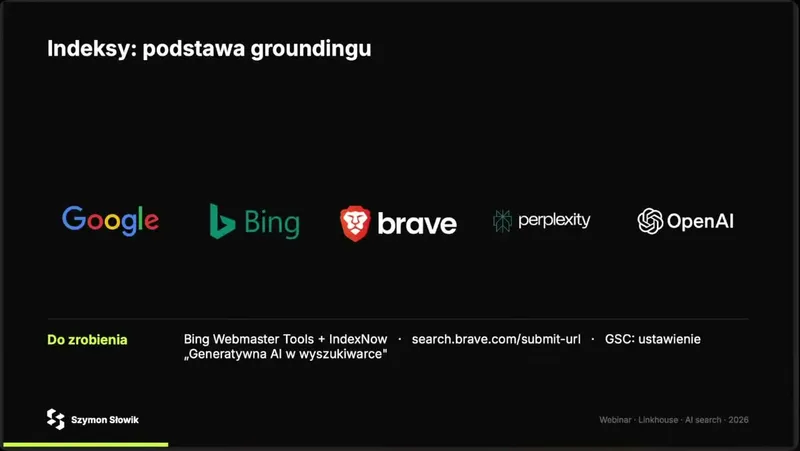
At the bottom of that slide there’s a to-do list, and none of it is new:
- Bing Webmaster Tools and IndexNow;
- submitting your site to Brave (search.brave.com/submit-url);
- the “Generative AI in Search” setting in Google Search Console.
I have an example of my own. ChatGPT cited my website in 38 of 70 answers: the homepage in 31 of them, a post about Sales Navigator pricing in 7, and a post about LinkedIn invitations and messages from the Escola Mobile podcast in 10 (one answer can cite several pages). It didn’t cite a single page of my training offer. Why? I don’t know yet. So I’m starting with the first item on Słowik’s list, Bing Webmaster Tools.
What did I find? Bing had trouble with 37 of the 185 URLs on my website: it didn’t know two of them at all, and it fetched 35 but stored none of their content. The cause was on my side. The IndexNow notification went out from the build about 11 seconds before the new version of the site was live, so Bing came for a fresh post, got a 404 error and didn’t come back for a long time. Since October 17 the notification goes out only once the site is live, and I’ve submitted the backlog of URLs by hand. I’ll check in a week how many of them make it into the index.
Do AI models reach LinkedIn trainers through their websites or through LinkedIn?
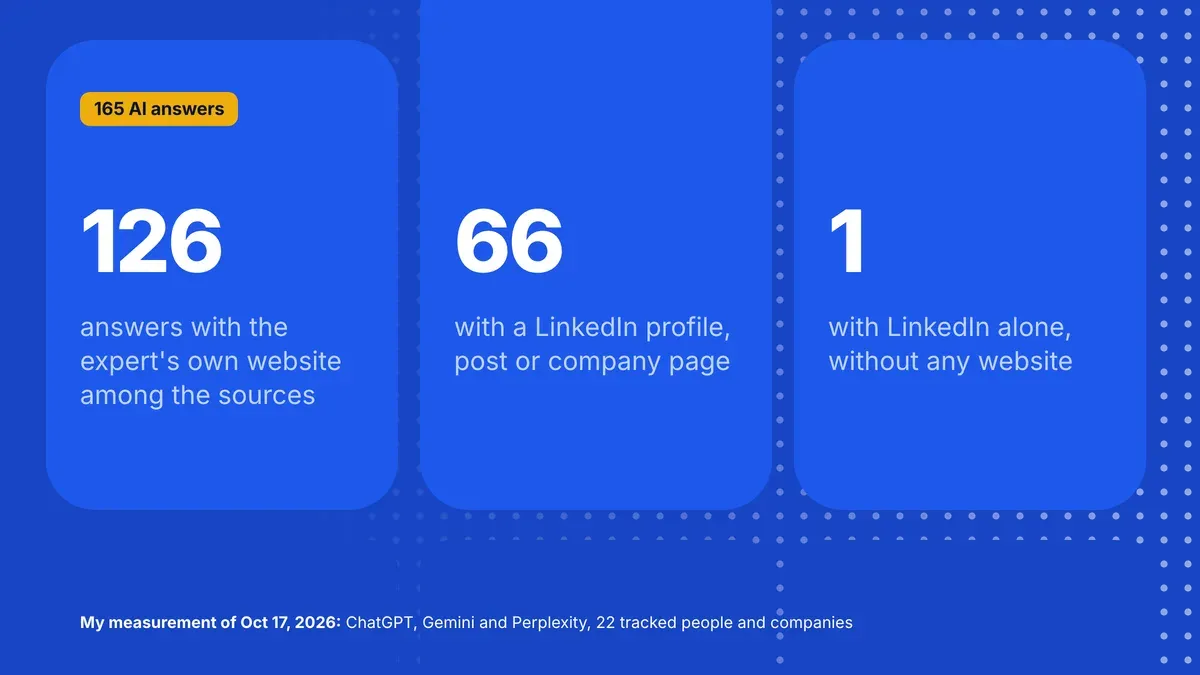
Through websites, more often. The questions were in Polish, about LinkedIn trainers in Poland. In 165 answers to questions without my name, the website of one of the 22 tracked people and companies (me and 21 competitors) was among the sources 126 times, and someone’s profile, post or company page on LinkedIn 66 times. LinkedIn alone, without any website, appeared in 1 answer. Four days earlier it was 120 to 58, so the ratio holds.
| AI model | Answers | Website | Both | Website only | LinkedIn only | Nothing from the list | |
|---|---|---|---|---|---|---|---|
| ChatGPT | 55 | 39 | 26 | 25 | 14 | 1 | 15 |
| Gemini | 55 | 33 | 0 | 0 | 33 | 0 | 22 |
| Perplexity | 55 | 54 | 40 | 40 | 14 | 0 | 1 |
| Total | 165 | 126 | 66 | 65 | 61 | 1 | 38 |
If I take myself out of the count, there are 108 answers with a competitor’s website, 57 with LinkedIn and 12 with LinkedIn alone. My own numbers are 100 answers with my website and 23 with my profile or company page on LinkedIn.
Does that mean LinkedIn doesn’t matter? No. In ChatGPT and Perplexity it shows up often, just almost always next to someone’s own website in the same answer. Gemini didn’t reach anyone on the list through LinkedIn even once.
Three caveats: these are two measurements four days apart, and the differences between them are within the noise; I queried the AI models through the API with web search (without Copilot or AI Overviews); and only the URLs I put on the list are counted. That list describes my niche, not the whole market.
What does LinkedIn’s own guide say about your website?
The same thing, only more quietly. Page 12 of the guide “Unlocking AI Search Visibility” says: “LinkedIn is a strong signal in AI search, but it isn’t the only one”. The guide goes on to say that AI models take into account everything they find about you: your website, your profiles and what you publish elsewhere.
It’s not the only place like that in LinkedIn’s guide:
- page 3 says traditional search engines still play a role;
- page 17 names a LinkedIn article or a blog post as the main piece that posts point to;
- the checklist on page 34 says to track AI Overviews in Bing Webmaster Tools and Google Search Console.
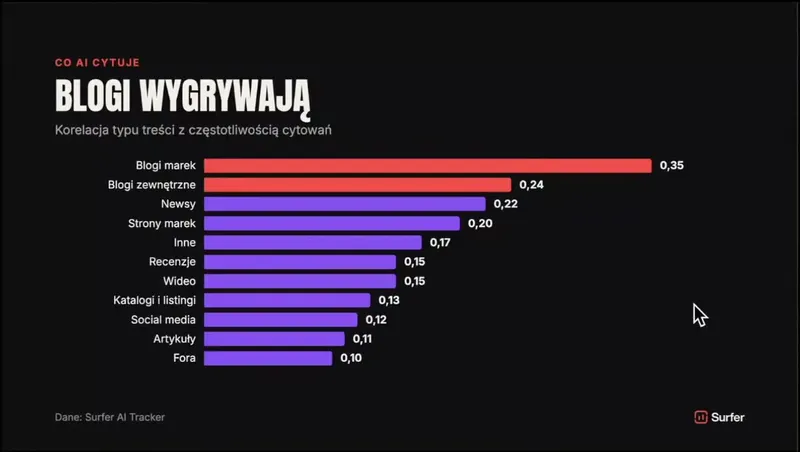
Surfer’s data points the same way. On Michał Suski’s slide, brand blogs have the highest correlation with citation frequency (0.35), and social media one of the lowest (0.12).
So what is LinkedIn’s role in the puzzle?
Just one piece of it. It’s good that it helps build visibility today: in my measurement linkedin.com is 30.4% of all sources in AI answers. But it should be complemented by other channels, because the same measurement shows that Gemini barely cites LinkedIn (five sources out of 549).
For me, LinkedIn is complemented by my website and my talks. For clients, newsletters and YouTube also work very well, with the content then recycled into LinkedIn posts.
What this means for your LinkedIn content is in LinkedIn AI visibility: how to get your content cited by AI search.
Is one measurement enough for both the Polish and the English market?
In my view, no, because the same topic has a different person asking and a different goal in each market. Back to the company from the Norwegian group at the start of this article: one purchase involves two people, one searching in Polish, the other checking in English.
The measurement shows the same thing. On similar questions without my name, the AI models mentioned me in 48% of answers in English and in 42% in Polish, but on Polish questions about training in English only in 36%. In Bing, 588 of 660 citations in AI answers went to my English pages, mostly how-to posts rather than my offer. If I added all of that up into a single score, I wouldn’t see where I’m strong and where I’m missing. So I define a market by the language and country of the person asking, not by the Google domain.
And where do enquiries about your offer come from?
FAQ: GEO, AEO and SEO
Maybe we can do something together?
If you like what I write, maybe I can write something for you?