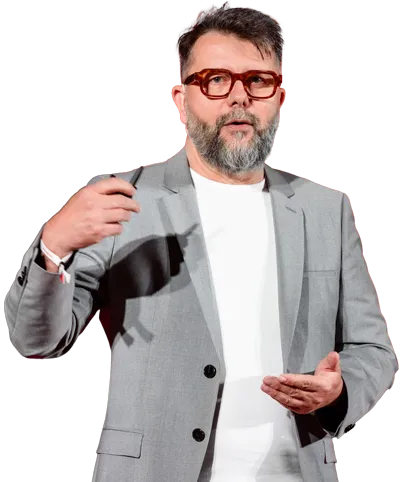
Depression Is the Kidnapper of Our Children: What I Said at TEDx and What Came of It
On the TEDxWarsaw stage I described how depression takes a teenager away from the family step by step, and why the parent is left alone with it. The talk now has over 128,000 views. Here is what I said, the signs we miss, two family attitudes that do harm, and what happened next.

Rafal Szymanski
Activist for the mental health and rights of children and young people
I have been working on the mental health and rights of children and teenagers since 2015, when my child was admitted to a psychiatric hospital. I ran "Porcelanowe Aniołki", a blog about depression in teenagers, gave the TEDx talk "Depression is the kidnapper of our children" and appeared in the documentary "Nic nie czuję" (I Feel Nothing). Since 2022 I have been an "expert by experience" on the Expert Commission for Mental Health Protection at Poland's Commissioner for Human Rights, an expert on the children and youth participation team of Poland's Ombudsman for Children and UNICEF, and an ambassador of the UNAWEZA Foundation's "Młode Głowy" (Young Minds) program. More about this work is on the Social activities page. My day job is something completely different: I train companies in LinkedIn.
Published On

Teenage depression does not arrive overnight. In my TEDxWarsaw talk I called it a kidnapper without a face, who takes a child away from the family in small steps and leaves the parent alone. The recording now has over 128,000 views and I still get messages about it. Here is what I said back then, what still holds true and what happened afterwards.
If you or your child need help right now
These are Polish numbers. In an emergency call 112. Children and teenagers: the Helpline at 116 111. Adults in crisis: 116 123 or the Support Center at 800 70 2222 (24/7). Parents and teachers worried about a child: 800 100 100. If you are outside Poland, call your local emergency number or crisis line.
In this article you will learn:
- why I decided to talk about my own child’s illness on stage;
- how to tell that depression is taking a teenager away from home;
- why nobody talks about children’s mental illness at work;
- which two family attitudes do a child more harm than good;
- what happened after the talk.
The whole talk (in Polish) takes under nine minutes:

Why did I take this on stage at all?
Because someone told me not to. A “personal branding expert” decided that I was doing something very wrong by talking about mental health in public and that I should sweep it under the carpet. The way it is done in every respectable Polish family.
By then I had spoken at a patients’ congress at the invitation of the Office of the Patient Ombudsman and given a few interviews. What I did not have was any literature, only my own experience. So I submitted teenage depression as a topic to TEDx. In June 2019 I walked onto the TEDxWarsaw stage; the theme of that edition was “DARE”.

Teenage depression is a kidnapper without a face
I started with a situation in which every parent feels safe. Your child is in hospital, you believe they are in good hands and you count the days until discharge. After several months in a psychiatric hospital my child attempted suicide. None of us had noticed what state they were in. Then the hospital discharged us and left us without help. I did not know where to look for it.
That is where the metaphor comes from. Depression works like a kidnapper without a face: in small steps, methodically, sometimes over several years, it takes your child out of your life. If you do not notice in time, you can lose them. That is why, to treat it, you have to talk about it out loud.
Why does nobody talk about children’s depression?
Because it is still a taboo, at work too. This is what I said on stage:
This happens because in my work and in business the rule is that we don’t talk about children. Talking about children with mental health problems is doubly forbidden. Because such illnesses don’t exist, because it’s impossible that my, your or his child could be ill. Depression is still a taboo and it leads to exclusion.
The mechanism is simple: an uncomfortable truth breeds shame, shame creates a taboo, and the taboo a spiral of lies with no room for support. The parent is left with guilt inside and accusations from outside. I write more about what this looks like in a company in the post on mental health issues as a workplace taboo.

Which signs of teenage depression do we miss?
What did people remember most? One image. Thick black tights and a long-sleeved hoodie on a warm day do not have to be your child’s style. Very often they cover signs of self-harm.
I also said that teenage depression was then often recognised only about two years after the first symptoms. All that time the parent, even if they see something, is alone with it. I talked about warning signs in more detail at the Dajemy Dzieciom Siłę Foundation debate, with a list of what I missed in my own child.
What can you do about it? Make the subject familiar in the family, among friends, at work. Not through big social campaigns, but face to face.
Denial and overprotection: two attitudes that do harm
In the family, depression sits down with us at Sunday dinner and everyone pretends it is not there. The most common reaction is denial. I heard: “this illness doesn’t exist”, “it didn’t exist in the old days”, “she’s just spoilt”, “in my day a belt was enough”.
What do I say to that? I compare it to tonsillitis. When your child has tonsillitis, you take them to the doctor, give them medicine and put them to bed. You do not expect them to pull themselves together and go to school tomorrow. Depression is an illness too.
The other extreme is overprotection: watching every step, checking the clock to see whether the child has been in the bathroom too long, pushing their favourite food, pushing them out for a walk. We do it because we believe we know better. Yet it is conversation that lets you understand what the child really needs.
The parent of a child with depression needs help too
And who helps the parent? On stage I said back then that depression affects 80% of carers of children with mental health problems. The parent struggles with guilt that maybe they could have done more, and with stigma, because instead of support there is judgement: “something must have been going on there, it’s the parents’ fault”. A parent like that needs help themselves and has no strength left to give it to the child.
But I ended with hope: depression can be treated, and treated well. Untreated, it kills. The hardest part is starting to talk about it.
What happened after the talk?
More than I expected.

The talk was translated into English and featured among ten health talks on the TED channel. Fragments of it appeared in films and books, and the makers of the documentary “Nic nie czuję” (“I Feel Nothing”) wove into it the part about depression at Sunday dinner and denial in the family.
Janusz Schwertner of Onet got in touch. His reporting led to the book “Szramy” (“Scars”) about how the system fails our children, and then to the film “Nic nie czuję”, in which I appear as a parent. Onet also organised a debate in Karpacz, which I write about in the post on child psychiatry in Poland. Since 2022 I have been a member of the Expert Commission for Mental Health Protection at the Polish Commissioner for Human Rights, as an “expert by experience”.
And the most important part? Since then, almost every day someone writes to tell me that after watching it they decided to start therapy or began talking about it at home. Some of my friends, on the other hand, have never watched it because they are afraid it will be too sad. I understand them.
Would I say anything differently on that stage today? No. So many years have passed and little has changed for the better. But that TEDx talk set off an avalanche of social action, hundreds of parents wrote to say it had helped them, and it inspired many people. I am glad I decided to do it.
If you would like me to talk about this at a conference or to employees of your company who are parents, see the page about talks on children’s mental health.
FAQ — teenage depression through a parent's eyes
Let's talk about children's mental health
I talk about teenagers' mental health crises from the perspective of a parent who is going through one. At conferences and in the media, and gladly at your company too, for employees who are parents.