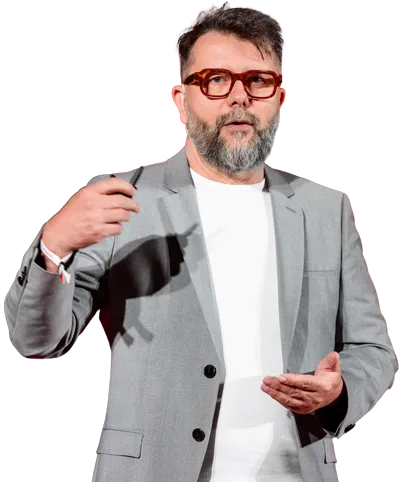
How to Talk About Suicide: I Was a Guest on TVP's "Hala odlotów"
In March 2026 I was a guest on "Hala odlotów", a talk show on Polish public television (TVP). The episode was titled "Suicide". At one table sat a film director, an actress, a priest who is a suicidologist, a mother who lost her daughter, and me as a parent. Here is what we talked about: how to speak about suicide in the media, why parents are not to blame and how to tell that a child needs help.

Rafal Szymanski
Activist for the mental health and rights of children and young people
I have been working on the mental health and rights of children and teenagers since 2015, when my child was admitted to a psychiatric hospital. I ran "Porcelanowe Aniołki", a blog about depression in teenagers, gave the TEDx talk "Depression is the kidnapper of our children" and appeared in the documentary "Nic nie czuję" (I Feel Nothing). I am an "expert by experience" on the psychiatry team at the office of Poland's Commissioner for Human Rights, an expert on the children and youth participation team of Poland's Ombudsman for Children and UNICEF, and an ambassador of the UNAWEZA Foundation's "Młode Głowy" (Young Minds) program. More about this work is on the Social activities page. My day job is something completely different: I train companies in LinkedIn.
Published On
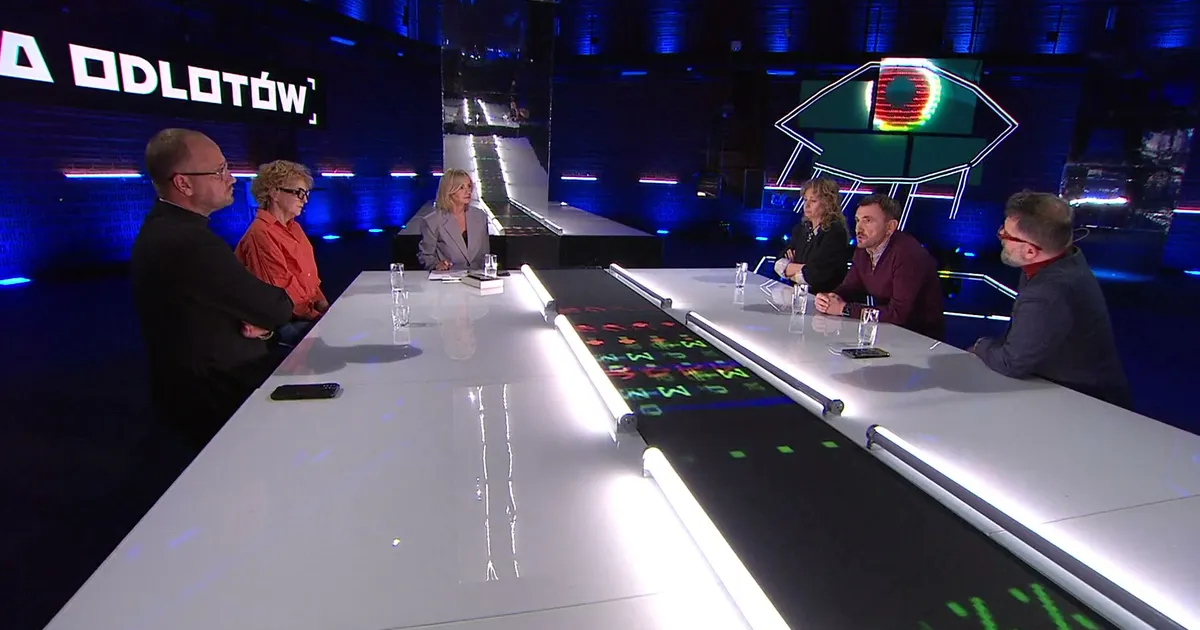
In this article you’ll find an account of the March 12, 2026 episode of “Hala odlotów” on Polish public television (TVP), titled “Suicide”: how to talk about suicide in film and in the media, why parents are not to blame, what happens to a parent when their child is taken to the emergency department, what the Church says about funerals today, and how to tell that an adult or a child needs help.
I was on the show as a parent. At the same table sat a director, an actress, a priest and a mother who buried her daughter 17 years ago.
Katarzyna Janowska, who hosts “Hala odlotów”, opened with a number: in Poland 13 people die by suicide every day. She closed by saying it was one of the hardest episodes she had ever hosted.
For me it was the hardest TV program too, and not only because of the subject. Originally there was one more person on the show, who made a scene, walked out and demanded that no footage of them be used. So the program had to be recorded from scratch, even though some questions had already been asked, and some emotions and tears had already come out, and nobody can repeat that. That is why I have enormous respect and admiration for the host: for her professionalism, her composure, and for leading the recording a second time so well that I recommend you watch it.
If you need help right now
These are Polish numbers. In an emergency call 112. Adults can call the Crisis Helpline at 116 123, children and teenagers the Helpline at 116 111. The Support Center for adults in a mental health crisis is available at 800 70 2222. If you are outside Poland, call your local emergency number or crisis line.
In this article you'll learn:
- who appeared in the “Hala odlotów” episode about suicide;
- whether suicide can be told with humor, and what the Papageno effect is;
- which two things the media should not do;
- why the myth of parental guilt does harm;
- what happens to a parent when their child is taken to the emergency department;
- how the Church approaches a funeral after suicide today;
- which warning signs show in adults and which in children;
- what the 3×P rule from the UNAWEZA Foundation’s “Młode Głowy” program is.
What the program was about and who appeared in it
“Hala odlotów” is a TVP program about culture and social issues, hosted by Katarzyna Janowska, a co-creator of the format. This program is one of the few reasons I own a TV set. I really recommend the format: talking about a difficult problem through art, and inviting people with different perspectives to one table to talk together.
Episode 190, aired on March 12, 2026, had two starting points: Maciej Żak’s film “Zapiski śmiertelnika” and the story of the poet Justyna Bargielska, who had been a guest on the show ten years earlier and in December publicly asked for donations to pay for her depression treatment.
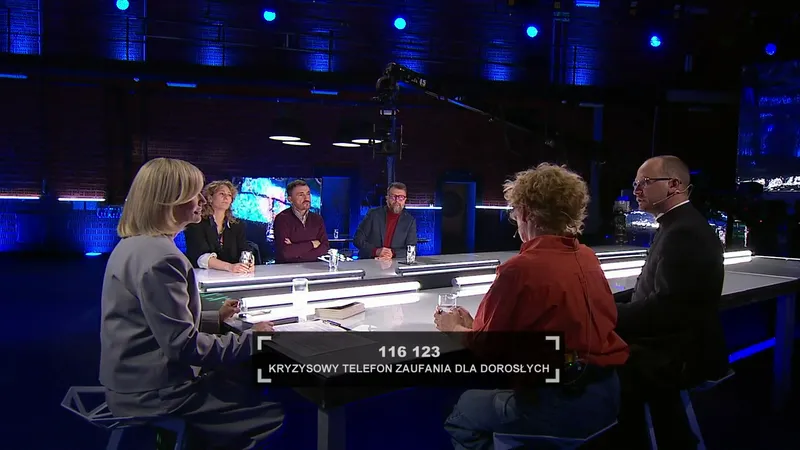
At the table sat:
- Maciej Żak, director and screenwriter of “Zapiski śmiertelnika”;
- Magdalena Popławska, the actress who plays the main character’s wife in the film;
- Fr. Tomasz Trzaska, a suicidologist and co-author of the book “Zniknąć bez słowa. Kiedy śmierć wydaje się być ratunkiem” (Vanishing without a word. When death seems like a rescue);
- Anna Malarowska, a music arranger and a mother whose daughter died by suicide;
- me, captioned on screen as a “social activist”, because I have been working on this subject for 10 years and have this kind of experience in my own family.
In the second part Hanna Rydlewska talked to Mariusz Treliński about his opera premiere, Richard Strauss’s “Die Frau ohne Schatten”. Then Treliński joined us at the table.
The whole episode is on TVP VOD (in Polish).
Can suicide be told with humor?
The conversation started with this question, because Żak’s film is about a man in his fifties who is preparing to take his own life, and at times it tells the story in a humorous tone. Doesn’t that trivialize the subject? It is an important question, and it was at the center of a heated discussion, after which we finished the recording in a smaller group. That shows how much it matters.
Maciej Żak answered that he does not show a method, only a way of thinking, and that the humor is there to give the viewer distance, so that the film does not pull them into a black hole. Magdalena Popławska added that her character, an unsupportive wife, is shown through the main character’s eyes. It does not mean the wife was like that, only that this is how a person in depression sees the world.
I added two terms the viewers might not know: the Werther effect and the Papageno effect. The first describes a situation in which a story about suicide is followed by more suicides. The second works the other way round: a story about getting out of a crisis protects. Both come from art: Werther from Goethe’s novel, Papageno from Mozart’s opera.
Why do I defend a film that may be getting it wrong? Because I am one of the people in the documentary “Nic nie czuję” (I feel nothing), and some of my friends told me they would watch neither the film nor my TEDx talk. They are afraid it is too sad and will pull them in. That is why I understand Maciej Żak’s position.
“Art has the right to be that kind of valve. Even if it’s wrong, even if it talks about it badly, even if it gets criticized afterwards.”
my words from the program
How to talk about suicide in the media
This question went to Fr. Tomasz Trzaska, who trains journalists and priests in exactly that. The World Health Organization has a handbook on it that runs to many pages; the Polish one is shorter and, as he said, not stiff at all.
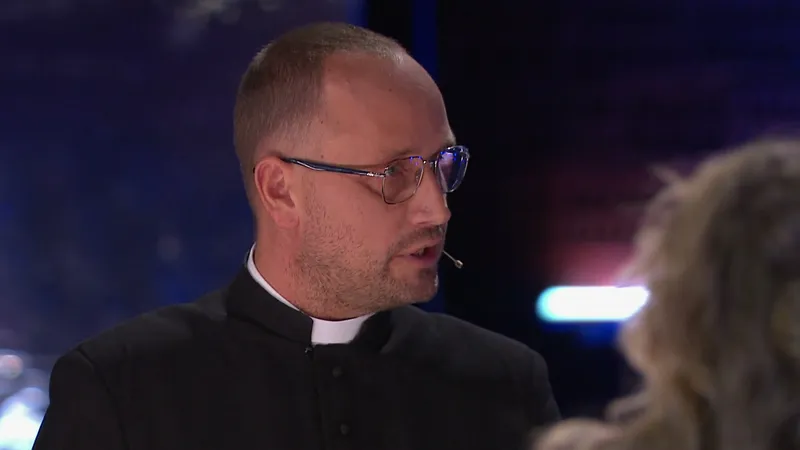
From the whole handbook he picked two rules:
- do not put the place or the method in the headline, because for a person in crisis such a headline is a pointer;
- do not point to the guilty.
He told us how he once called the newsroom of a local news site after exactly that kind of headline and asked whether they would take moral responsibility for it (there is no legal responsibility in Poland).
And why not point to the guilty? It is enough to read the comments under a report on a child’s death: I wonder what was going on at home, I wonder what the parents failed to notice. Fr. Trzaska knows those parents. They tell him they are afraid of losing their minds, not from the loss itself, but from the hate.
Are parents to blame?
Katarzyna Janowska asked Anna Malarowska whether she feels her daughter could have been helped.
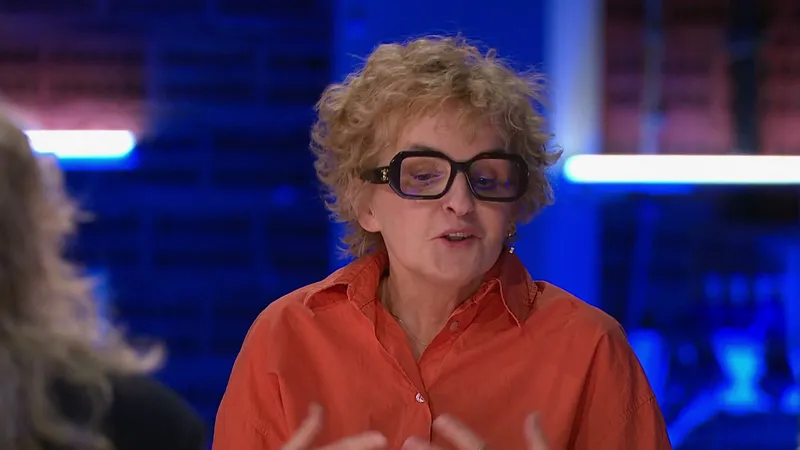
She answered that this way of thinking leads nowhere, because there is no good answer to that question, and parents will keep asking it for the rest of their lives anyway. What saved her was thinking ahead: what she could do with this experience, whom she could help. She did not want to be, as she put it, a mother walking in black until the end of her days.
I said then that we share that experience. I am a father of four. One of my children has been diagnosed with a serious illness, and we have suicide attempts behind us.
So what about the guilt? If I do not put a helmet on my child for a bike ride and they fall and hurt their head, that is my fault and my negligence. On my child’s mental disorder, in most situations, I have no influence (I am not talking about extreme cases such as violence). Doctors still say that depression can have a genetic, social or situational background.
The myth does harm for a simple reason: parents who feel guilty do not ask for help. And the worst part is that a parent can know all this and still eat themselves up inside. I thought I had that behind me too. But I remember how I felt when my child was admitted to the hospital and how hard I looked for the fault in myself.
Fr. Trzaska added that he keeps telling parents “it is not your fault”, and that it is neither a platitude nor a pat on the back.
What happens to a parent when their child is taken to the emergency department
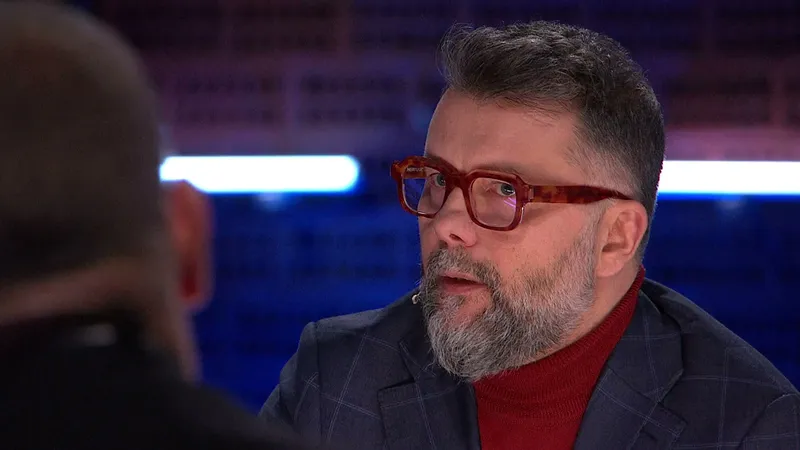
I talked about children, because that is my experience. The moment a child passes through the airlock of the emergency department, they become a patient. Strict rules apply, and parents are treated as a nuisance: nobody gives them information and there is no support program for them. A parent who has brought in a child after an attempt is left on the other side of that door alone.
That is where my activism began. It was 2015, and when I started looking for places where a parent can get help, it turned out there was no such list. I reached the Patient Ombudsman’s office and heard: well, let’s prepare one. Director Grzegorz Błażewicz from the Ombudsman’s office made it happen: a few A4 sheets with verified addresses.
Today there are more such places. In the same year I started a blog about depression in teenagers, the first of its kind back then. Today there are hundreds, and that is a good thing.
I also said something about the statistics. From my conversations with parents and police officers I know that some of these deaths never make it into them. Why? Because the family does not want the community to find out, so the paperwork says traffic accident or medication poisoning. Specialists say that for this reason the real number of deaths may be up to 10 times higher than reported.
The Church and a funeral after suicide
The host recalled that there was a time when people who took their own lives could not count on a funeral Mass or a place in the cemetery. What is it like now?
Fr. Trzaska separated theory from what happens in parishes. Church law changed in the 1980s: the provision ordering a funeral to be refused was removed. Before that it applied to people who had taken their lives consciously, and yet a person in that state has narrowed perception. From people who survived an attempt the priest hears: that wasn’t me.
And in a small town, where everything depends on the parish priest? Changes come slowly, and as late as the 1990s it happened that a priest “did it his own way”, for example by cutting the rite short. Fr. Trzaska does not know of a refusal, except where the deceased had declared themselves a non-believer.
Over the last few years he has trained several thousand priests and nuns. What for? Because a small town has no psychiatrist, and if it has one, people are ashamed to go. A priest in the confessional or in a religion class is sometimes the first person to pick up the signals and send someone on, to a mental health center.
Men: 11 out of 13
We talked a lot about children, and Maciej Żak brought back the number he made the film for: of the 13 people who take their own lives every day, 11 are men.
No sources were given on air, but these are official figures from the Polish National Police Headquarters.
What surprised him at the meetings after screenings? That men aged 40 to 55 started talking about it. One woman stood up and thanked him, because thanks to the film she understood why her husband had done it.
Żak also described an argument that broke out between viewers and therapists during the discussion after the film’s premiere screening. Men approach life analytically and as a series of tasks, this decision included. Someone in the audience objected that therapy is feminized and that “let’s talk” alone is not enough for a man. Sometimes it helps when someone just sits next to you, and sometimes it doesn’t.
I know the subject is deadly serious, but as a father of four I immediately remembered a scene from “Ice Age 3”, where the main character, a mammoth, tries to talk about emotional problems with his friend, a saber-toothed tiger. It doesn’t work and they sit in silence. The punchline is: and that’s how the mammoths went extinct.
Magdalena Popławska spoke from her own experience: there were suicides in her family, and her father died that way too. In her view you have to try every way of reaching a person: humor, therapy, conversation or silence. Nobody should get to decide which way is good and which is bad.
What has changed in 17 years
Anna Malarowska compared two phone calls from school, 17 years apart. When she used to go to her daughter’s school and ask whether anyone had noticed anything, she heard that nobody had seen a thing. Recently a friend of hers, who had noticed nothing wrong with her son herself, got a call from the school psychologist: something is going on with your son.
She also said that when someone at home has depression, the whole family is ill, and that until the end she did not believe the worst would happen. There always seemed to be one more way out: another therapy, another hospital, a clinic abroad. Back then she looked for knowledge on American and British websites, because there were no Polish ones.
Warning signs in adults and in children
Toward the end the host asked for the “red flags” that must not be missed.
Fr. Trzaska listed the ones that apply to adults. They do not all have to appear at once:
- low mood and withdrawing from contact;
- sentences like “you’ll be better off without me”, or asking who will come to my funeral;
- coming back to the subject of death again and again;
- sleep: waking up at two in the morning for no reason and lying awake until four, night after night.
And children? They get ill a little differently, so I added what I know as a father:
- trouble with sleep, attention and concentration;
- the child suddenly studies more, because they can see they are no longer coping and try to make up for it (the parent thinks things are great);
- they withdraw from their peer group;
- they start dressing differently, to cover self-harm;
- they become explosive and nervous, although they weren’t like that before.
Each of these things on its own can be explained by something else. It is several at once that should set off the alarm.
What do you do then? At the UNAWEZA Foundation, in the “Młode Głowy” (Young Minds) program, of which I am an ambassador, we teach psychological first aid in three steps. It is the 3×P rule, in Polish popatrz, posłuchaj, połącz: look, listen, link. First assess the situation and notice that something is going on. Then listen, without judging and without giving advice. Only at the end help the person find support, for example a psychologist. All three steps are described on the helpPPP site (in Polish).
The middle step is an appeal mostly to us men. I have a son and otherwise only daughters, and it took me a long time to learn that when a child comes to me with a problem, I am not supposed to look for a solution right away. In the film “Nic nie czuję” my child says they hold that against me.
Where to look for help
Four addresses came up in the program:
- Fr. Trzaska recommended the platform Życie warte jest rozmowy, with free guides and consultations for people in crisis and after a loss, where you can also write to a specialist;
- Maciej Żak recommended podcasts about men’s problems and mentioned Masculinum. It is a foundation for men, and its co-founder and president, psychotherapist Jacek Masłowski, runs the YouTube channel Czasem czuły, czasem barbarzyńca with conversations about what men struggle with today;
- I added the 3×P rule and the helpPPP site described above;
- the numbers 116 123 (adults) and 116 111 (children and teenagers) kept returning on screen.
All of these are Polish-language resources and Polish numbers. If you live elsewhere, look for your local crisis line.
Mariusz Treliński, who listened to the end of this conversation, said it feels awkward to talk about opera next to a subject like this. He added, though, that art lets you look at yourself from the outside, and that in “Die Frau ohne Schatten” it is love that leads the characters out of depression.
After the program, as the credits rolled, Fr. Trzaska said one more thing: jokes come up regularly at his training sessions. People from the room next door ask whether it is a suicide prevention course or stand-up. You cannot, as he says, listen to this for three hours at the highest pitch.
FAQ — how to talk about suicide
Maybe we can do something together?
If you like what I write, maybe I can write something for you?