Child Psychiatry in Poland: Lessons from the Debate at the Economic Forum in Karpacz
In September 2021, at the Economic Forum in Karpacz, I took part in Onet's panel on child psychiatry together with a psychiatrist, a member of parliament and a former Deputy Commissioner for Human Rights. I was there as the voice of parents. Who spoke, which numbers were quoted and what from that conversation still matters today.

Rafal Szymanski
I implement LinkedIn and Sales Navigator in companies so they turn a profit.
I've been training people in LinkedIn since 2016 — more than 5,000 of them, across 200+ B2B companies. Founder of B2B Marketing.AI, a CRM platform for advanced LinkedIn users. I help sales and marketing teams turn LinkedIn into a predictable source of leads. I've spoken about LinkedIn at the biggest conferences, including I Love Marketing, InfoShare and Effie, and picked up a few awards along the way.
Published On
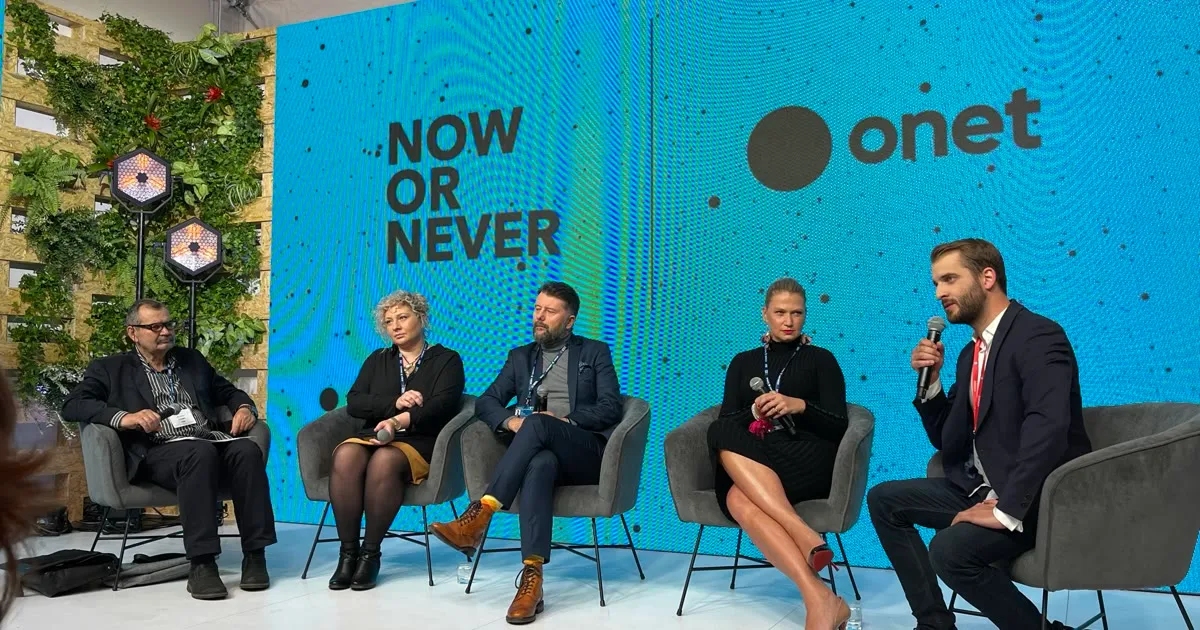
In this article you’ll find an account of the debate on child psychiatry in Poland that Onet organized at the Economic Forum in Karpacz in September 2021: who spoke, how much the state was spending on one child’s mental health, why one missing ward breaks the whole system, what the panelists thought of the reform and where a parent can look for help. Plus my own story as a parent whose child was treated in a psychiatric hospital.
At the end I also share my conclusions and observations on what has changed in child and adolescent psychiatry over the last 5 years, and what it has to do with a Disco Polo Museum.
At the Economic Forum people talk about the economy, energy and money. This time Janusz Schwertner of Onet put a psychiatrist, a member of parliament, two ombudsman officials and me, a parent, on the stage. He started with where this debate came from: not from a wish to have a chat, but “from anger, fury, frustration, irritation and shame”.
If a child is in danger right now
In Poland, call 112. Children and teenagers can talk to the Helpline for Children and Young People 116 111; adults worried about a child’s safety can call 800 100 100. Outside Poland, call your local emergency number.
In this article you'll learn:
- who took part in the debate on child psychiatry at the Economic Forum in Karpacz;
- what a psychiatric hospital for children looks like from a parent’s side;
- how much the state was spending on one child’s mental health;
- why one missing ward breaks the whole system;
- what the panelists said about the reform of child and adolescent psychiatry;
- where a parent’s sense of guilt comes from and where to look for help.
What the debate was about and who took part
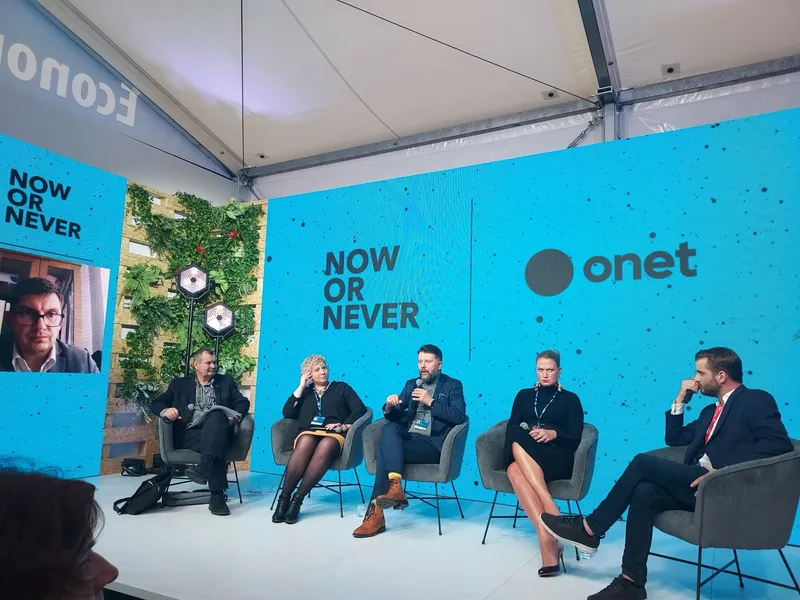
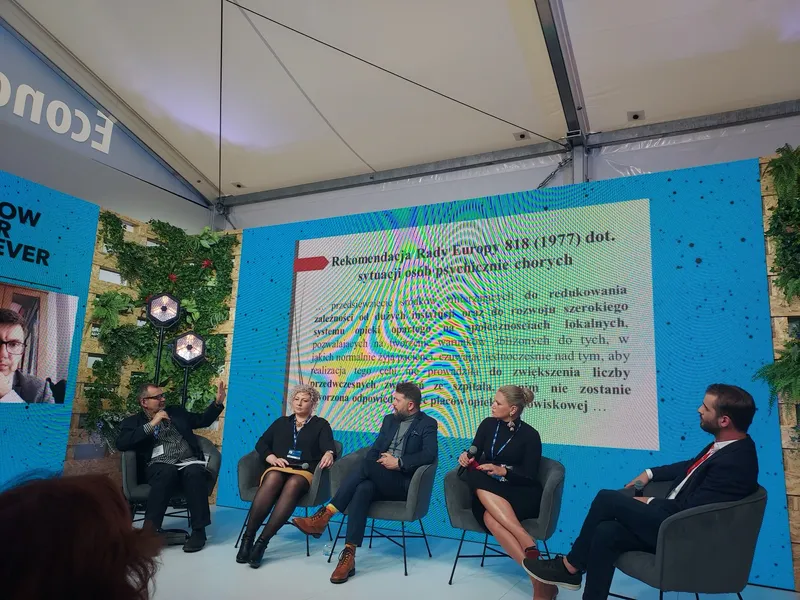
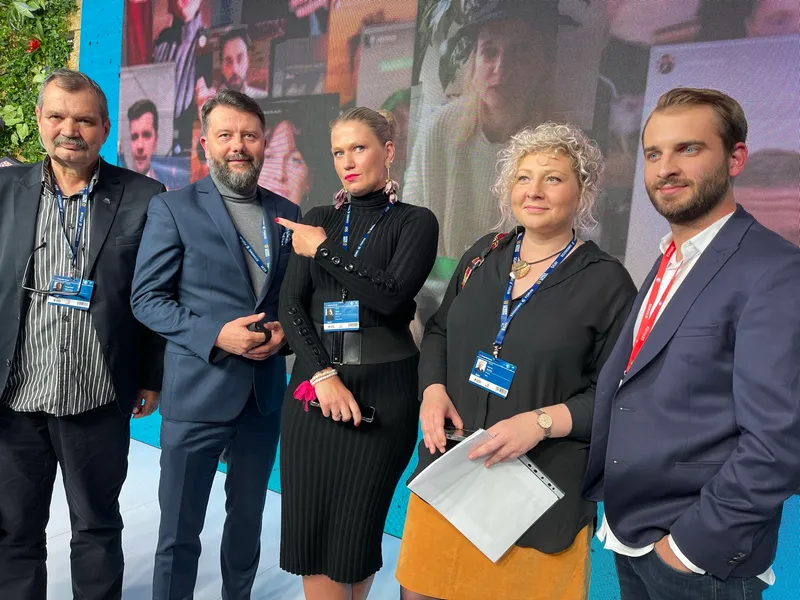
The debate took place on September 7, 2021 on Onet’s stage, under the banner “Now or Never”, and was streamed live. It lasted an hour and a half. Towards the end Marta Golbik said that a panel on child psychiatry at the Economic Forum was something that “has never happened before”.
Six people took part:
- Janusz Schwertner, Onet journalist, author of the reportage “Miłość w czasach zarazy” (Love in the Time of Plague) and co-author of the book “Szramy” (Scars), as host;
- Maja Herman, psychiatrist and psychotherapist;
- Marta Golbik, MP for the Civic Coalition, who at the time led the parliamentary group dealing with child psychiatry;
- Krzysztof Olkowicz, former deputy to Commissioner for Human Rights Adam Bodnar, the office’s coordinator for mental health protection;
- Grzegorz Błażewicz, Deputy Patient Ombudsman, who joined from Warsaw;
- me, as a parent and social activist.
An important note: all the numbers and assessments in this text come from September 2021. I record them as they were said, because they show where we were starting from. At the end I try to give current figures to show what has changed since that debate.
The full recording (in Polish) is on YouTube:

Does child psychiatry in Poland exist?
That was the question Janusz Schwertner opened with. Maja Herman answered that you could say it doesn’t, because the collapse of psychiatry is the result of years of neglect. Whose? Politicians’, but also that of doctors and psychotherapists themselves, who lacked the clout or the motivation. I’ll add a controversial thesis of my own: for some of them this situation is a convenient way of securing their income.
Janusz added an example from his own reporting: in the whole Podlaskie province there was not a single 24-hour child psychiatry ward at the time. A child after a suicide attempt got into an ambulance and went looking for a bed hundreds of kilometers away. According to the statistics he quoted, every three days a young person in Poland took their own life.
Maja Herman also pointed out what sets this field apart from the rest of medicine: in child and adolescent psychiatry there is never just one patient, because behind the child comes the whole family system.
What a psychiatric hospital for children looks like to a parent
This is where I came in with my story. When my child first ended up in the hospital in Józefów near Warsaw, I got up at five in the morning to catch the doctor at seven. What for? To get permission for a visit, because permission was granted on the day, for that day. I couldn’t have a standing permission to visit, I had to “earn” it every day, or rather my child had to earn it.
For the first weeks no doctor saw my child. There was one psychiatrist for thirty-something children, in twice a week, so the first conversation with a doctor took place after about four weeks.
Then my child attempted suicide in that hospital. It happened in the evening, and my child reached intensive care the next morning. If the dose had been bigger, it would have ended in tragedy. Janusz Schwertner asked whether he understood correctly that the staff hadn’t noticed. He understood correctly.
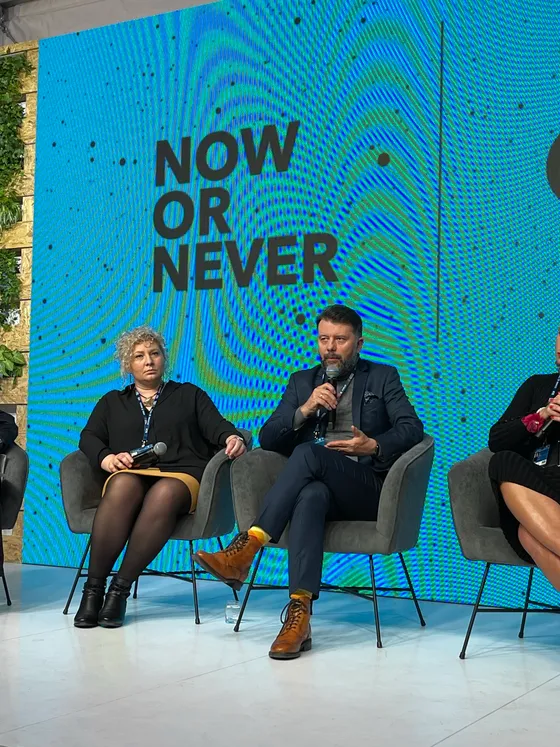
Where did my charity work come from? From Józefów. My child was a vegetarian and didn’t eat for several days, because supper was bread with pale cold cuts. Back then we were buying flour and sugar for the ward so the kids could bake cookies or a pizza. The first fundraiser, a few thousand złoty, went on exactly that. I said from the stage that I’m f***ing furious about it, because this is the state’s job, not a parent’s and not Jurek Owsiak’s (the man behind Poland’s biggest charity fundraiser).
Marta Golbik summed up stories like this with one distinction: the state can stay out of the way, it can help, or it can get in the way. Listening to parents, she has the impression that it gets in the way.
How much the state was spending on a child’s mental health
Krzysztof Olkowicz came with a presentation and with Article 68 of the Polish Constitution, which obliges public authorities to ensure special health care for children. Do the authorities do that? His answer: definitely not.
The numbers from his slides, meaning the payer’s (the National Health Fund’s) annual spending on mental health per child at the start of the reform:
| Type of care | Per year | Per month |
|---|---|---|
| outpatient | PLN 7.00 | PLN 0.58 |
| day care | PLN 3.50 | PLN 0.30 |
| 24-hour | PLN 12.80 | PLN 1.07 |
| total | PLN 23.45 | PLN 1.95 |
Maja Herman asked the audience to look at these numbers as something other than a table:
“These figures are the price of your children’s health and lives. Yours and ours.”
Maja Herman
Olkowicz also showed photos from ward inspections and told the story of the hospital in Zabór, housed in the former palace of the second wife of Kaiser Wilhelm II. The Kaiser’s grandson came to see the palace, went home and asked his family for a fundraiser instead of birthday presents. The money bought mattresses, pillowcases and pillows. Olkowicz’s comment: if our wards are being supported by the grandson of Wilhelm II, all of us adults should be ashamed.
He came back to the Constitution at the end with an anecdote told by Prof. Ewa Łętowska. A customer in a restaurant orders a pork chop, then a meatball, then dumplings, and each time hears “we don’t have it”. So he asks the waiter: “What am I reading then, the menu or our constitution?”
Why one missing ward breaks the whole system
Grzegorz Błażewicz talked about what comes out of the complaints reaching the Patient Ombudsman: conditions on the wards, objections to the treatment, and in the background the pandemic, remote schooling and domestic violence. About Podlaskie he said that a 24-hour ward in Białystok was realistic in 2023–2024, and that a meeting with the provincial governor held over a year earlier “led to nothing”.
Janusz Schwertner set this against another announcement from the same province: there is no ward for children, but a Disco Polo Museum is to be built. He also worked out aloud that during the three years of waiting for the ward, according to the statistics, more than 300 young people would die. Grzegorz Błażewicz would not comment on the museum idea; he only said that priorities need to be named and followed.
He called it a system of communicating vessels. How does that work? If a province has no ward, a young doctor has nowhere to do the specialty, so the province gets no new psychiatrists.
I added a scene from outside the hospital in Józefów. An ambulance pulled up, the paramedics brought out a patient in restraints, got a signature and drove off. Her mother was left in the parking lot, an elderly woman, just as she stood: no coat, no money, no documents. She asked me where the railway station was and whether I could lend her money for a ticket. She had come in that ambulance from Pomerania, several hundred kilometers, because there was no bed in Gdańsk.
What follows from that? Two things. A child taken to another province will not be visited by their family, and a small child experiences that as being abandoned. And if patients from Podlaskie and Pomerania arrive in Józefów, there are no beds left for children from Mazovia.
The hardest story in this part also came from Gdańsk and from Janusz Schwertner’s reporting. There was no place for a fifteen-year-old girl on the adolescent ward, she was put on an adult ward and was raped on the first night. The case concerning the hospital’s responsibility was dropped. Krzysztof Olkowicz added that he had spoken to the head of that ward the same day and it was still overcrowded, and a doctor still had no procedure for the moment when another child is brought in and there are zero beds.
The reform of child and adolescent psychiatry: right direction, execution at risk
In January 2021 the prime minister and the health minister announced at a press conference that within a year the situation would change by 180 degrees. The reform was to be the basis: hundreds of centers across Poland with no doctor but with a psychologist or psychotherapist, meaning quick help when a psychiatrist isn’t needed yet.
Everyone agreed on the direction. Grzegorz Błażewicz said nearly 300 such centers were operating, and the Patient Ombudsman was collecting information from them about problems and good practices.
Krzysztof Olkowicz showed where it was falling apart:
- the first National Mental Health Protection Program ended in failure, and the second was to run until 2022;
- the government’s report on the program for 2017–2018 reached the Sejm on December 11, 2019, and for almost two years the Health Committee did not take it up;
- adult psychiatry is paid as a lump sum per population, while child psychiatry is still paid fee-for-service, which in his view is destroying it;
- the heads of the new centers wrote to the minister on April 26, 2021 and nobody met with them, and some centers received a demand from the National Health Fund to return money;
- the director of a center in Gdańsk had told him the day before that she had just replaced her entire staff for the seventh time.
As a parent I’m rooting for this reform for one reason: it breaks down stigma. You go to a center like that simply for help, not “to the psych ward”, and often that means a hospital isn’t needed at all. I also raised a demand that I, as a parent, shouldn’t have to make: there is no law regulating the profession of psychotherapist. Treatment needs both a psychiatrist and a psychotherapist, and both need to know how to work together.
Marta Golbik recalled how the subject got into politics in the first place. The Senate, with the votes of the ruling party’s senators, rejected an amendment giving child psychiatry an extra PLN 80 million, the case became loud and the government promised 200 million. She saw the politicians’ job as making sure that money gets spent, and spent well.
Why psychiatrists leave public hospitals
Maja Herman talked about herself. Five years earlier she had left the public health service. As head of a forty-bed acute admissions ward she was taking home PLN 15 an hour.
And the younger ones? Doctors two or three years into the job are so exhausted they want to change specialty. Each patient should have a team: a psychiatrist, a psychologist, a psychotherapist, a social worker, a nurse, a teacher, and ideally an art therapist too. On the day of the debate she asked her fellow women doctors in a closed group what she should say in Karpacz, and heard about a ward, the only one in its province, with not a single psychotherapist, because the only one employed was on maternity leave.
Why doesn’t it change, if everyone knows it’s bad? Her answer is what I remember best from the whole debate:
“Psychiatry is ugly. It’s not sexy and it doesn’t show immediate results. To get an improvement in a family, it isn’t one, two, three sessions. It’s two, three, four years.”
Maja Herman
Marta Golbik added that doctors who have to decide which child gets a bed on the ward are themselves victims of this system.
Language came up too. Maja Herman asked the audience never to use the phrase “LGBT ideology”, because calling people an ideology dehumanizes them. For a psychiatrist this is not a political dispute, it is the stories of children who keep hearing that something is wrong with them.
A parent’s guilt and stigma
Janusz Schwertner asked me what a parent feels on learning that their child has attempted suicide. Guilt from within and accusations from outside. If I say publicly that my child was in a psychiatric hospital, the child becomes “the crazy one”, and I become the father of the crazy one and a monster. That is why parents hide the illness even within the family. In my TEDx talk I called it a terrorist sitting with us at the table while everyone pretends he isn’t there.
I also said things I rarely talk about. I had to hide my child’s mental illness. My relationship fell apart. I learned to cry on the inside, because a younger sister was taking it very hard and I had to be strong for her. Except that parents aren’t made of rock. Maja Herman put it with the airplane comparison: the oxygen mask goes on the parent first, then on the child.
What does the psychiatrist say? That the conclusion people around you reach is always the same, “bad parent”, and always false, because mental disorders have several causes at once and no single one can be isolated.
“There is no good or bad parent, there is a good enough one. That word makes a big difference.”
Maja Herman
From parents she keeps hearing one sentence: we thought we were the only ones in the class. And when someone says it out loud first, it turns out half the class has already been in contact with a psychologist. It was the same for me. Until I started a blog about teenage depression and gave my TEDx talk, I thought I was alone with it.
Grzegorz Błażewicz quoted the director of one of the hospitals: there are circles where it is acceptable to boast about a heart attack from overwork, but not about a stay in a psychiatric hospital. The Patient Ombudsman had proposed to the ministers of education and health a school subject called “health knowledge”, with a block on mental health, in primary and secondary schools.
To close this part, money. The host told the story of a mother who received an inheritance, about PLN 100,000, and was paying 13,000 a month for a private center. She told him that for that sum she had bought herself, in Poland, respect for a child in crisis. I added that fewer and fewer parents can afford treatment for their own child: before the pandemic a visit to a good psychiatrist cost about PLN 200, and by autumn 2021 I was hearing about 300 and more.
Where a parent can look for help
When my child went into hospital, I had no help and didn’t know how to find any. So when the Patient Ombudsman’s office asked me what it could do, I asked for a list of organizations a parent can turn to after handing their child over to a hospital. Ideally on a sheet of paper, given out at admission.
That list was created and the Ombudsman keeps it up to date: list of organizations working for mental health (in Polish). The problem is the same as back then: you have to know it exists.
What else was said:
- the Patient Ombudsman’s free helpline is 800 190 590, and after a report the Psychiatric Hospital Patient Ombudsman tries to meet the patient within seven days;
- Poland had 34 24-hour psychiatric facilities for children and adolescents at the time, and these ombudsmen were permanently present in 19;
- Janusz Schwertner appealed to the government to fund the helpline for children and young people 116 111, which the state was then funding at 5%.
What positive things were left at the end
The host asked everyone for one positive sentence.
Maja Herman talked about the young generation of doctors who speak about their own disorders on social media and in that way take the stigma out of psychiatry. Marta Golbik about the people she has met since she took up this subject, and about the group making sure the bursts of effort keep coming. Grzegorz Błażewicz about the fact that there used to be no Patient Ombudsman at all.
I thanked us as a nation, because in bursts we can do big things. And the fact that more and more people are taking off their masks and talking about their mental health problems, from my friends to complete strangers. If we adults aren’t well, our children won’t be either.
Krzysztof Olkowicz’s words hit hardest. His neighbor works at an employment office. A young man came to her, she could see he was going through something hard, so despite the queue she gave him more time and asked him to come back in a week. He came back with a rose. He said he had already had a plan and knew which railway crossing in Gdańsk he would throw himself under, but he felt he had to come and see her in a week.
After the close, Joanna Sekuła spoke from the audience and invited the parliamentarians to a meeting with the authors of the ABC of Empathy program, which teaches the youngest children to cope with their emotions.
What has changed after five years
I checked what happened to the things we talked about in Karpacz. This is the state of play at the beginning of October 2026.
The ward in Białystok was built, and sooner than announced. The Center for Child and Adolescent Psychiatry with a 24-hour ward opened on October 7, 2022, thirteen months after our debate. It cost PLN 40 million, of which almost 23 million came from the state budget and 17 million from European funds.
And the Disco Polo Museum? It was announced in 2020 in Michałowo near Białystok as part of a Disco Polo Center costing PLN 11 million, to be built in 2024–2026. I found no information that it has opened. It looks as though this time the children’s ward came first.
There are more first-level centers. From nearly 300 in September 2021 they grew to 403 in July 2023, plus 136 second-level facilities and 32 third-level ones with 24-hour wards.
There is more money too. According to the Ministry of Health, National Health Fund spending on child and adolescent psychiatry rose from PLN 258.7 million in 2019 to 737.7 million in 2022, and the plan for 2023 exceeded one billion. I found no new “per child” amounts calculated the way Krzysztof Olkowicz’s slides did it, so I worked it out myself, using the same number of children and adolescents he gave from the stage (7.63 million): that comes to about PLN 34 a year in 2019, 97 in 2022 and over 130 in 2023, against 23.45 at the start of the reform. These are my estimates, not National Health Fund data.
Was that enough? The Supreme Audit Office, in its report of September 2024, wrote that it wasn’t:
- in 2022 care reached 3.5% of children and adolescents, while about 9% needed it (the same 9% Olkowicz talked about in Karpacz);
- waiting lists grew by more than 100%, about 10,000 people, between the end of 2020 and March 2023;
- there were 7.8 doctors per 100,000 patients against a recommended 10;
- in three provinces there was not a single day ward.
The law on the profession of psychotherapist, which I called for from the stage, still doesn’t exist. An MPs’ bill reached the Sejm in February 2025, had its first reading in July 2025, and in July 2026 the Health Committee put its report off until September. That committee is now chaired by Marta Golbik, who sat next to me in Karpacz.
The 116 111 helpline had an even worse year after the debate: in 2022 it lost its state grant entirely. Since 2024 it has been funded from the state budget.
The school subject about health that the Patient Ombudsman was pushing for entered schools on September 1, 2025 as optional health education. From the 2026/2027 school year it is compulsory in grades 4–8 and for two years in secondary schools, and mental health is one of the compulsory sections.
The statistics Janusz Schwertner opened the debate with look worst of all. In 2021 the police recorded 1,496 suicide attempts by children and teenagers, 127 of which ended in death. In 2025 there were 1,925 attempts and 161 deaths in the 7–18 age group. “Every three days” from 2021 is now more often than every three days.
You can read more about what I do in this area on my social activities page, in the Economic Forum in Karpacz portfolio entry and in the posts about other debates: Child and Youth Mental Health: A Plan for Mazovia and How to Help a Child in a Mental Health Crisis: Lessons from the FDDS Debate.
Sources
The sources are in Polish.
- Economic Forum in Karpacz. Debate on child psychiatry, recording of Onet’s live stream, September 7, 2021
- Opening of the Center for Child and Adolescent Psychiatry in Białystok, University Children’s Clinical Hospital in Białystok, October 2022
- A Disco Polo museum will be built in Poland. It will cost PLN 11 million, Polsat News, June 9, 2020
- Child psychiatry reform: 403 community care centers already operating, Co w Zdrowiu, July 24, 2023
- Child and adolescent psychiatry: how much does the National Health Fund spend on it?, Co w Zdrowiu, April 11, 2023
- Child psychiatry needs fixing, Supreme Audit Office (NIK), September 10, 2024
- What’s next for the bill on the profession of psychotherapist, Rynek Zdrowia, July 15, 2026
- Helpline for Children and Young People 116 111. Funding from the state budget, TVN24, December 15, 2023
- Health education will be a compulsory subject from September 1, Ministry of National Education
- Report on suicidal behavior among children and adolescents, 2012–2021, “Życie warte jest rozmowy” service, based on National Police Headquarters data
- Police release the latest data on suicide attempts by children and adolescents in 2025, Głos Nauczycielski, January 22, 2026
- Current list of organizations working for mental health, Patient Ombudsman
FAQ — child psychiatry in Poland
Maybe we can do something together?
If you like what I write, maybe I can write something for you?