How to Help a Child in a Mental Health Crisis: Lessons from the FDDS Debate
A debate held by Poland's Dajemy Dzieciom Siłę Foundation on how to recognise a mental health crisis in a child and where to find help. Who took part, what we agreed on, and what I said as a dad about red flags, the care system and school.

Rafal Szymanski
I implement LinkedIn and Sales Navigator in companies so they turn a profit.
I've been training people in LinkedIn since 2016 — more than 5,000 of them, across 200+ B2B companies. Founder of B2B Marketing.AI, a CRM platform for advanced LinkedIn users. I help sales and marketing teams turn LinkedIn into a predictable source of leads. I've spoken about LinkedIn at the biggest conferences, including I Love Marketing, InfoShare and Effie, and picked up a few awards along the way.
Published On
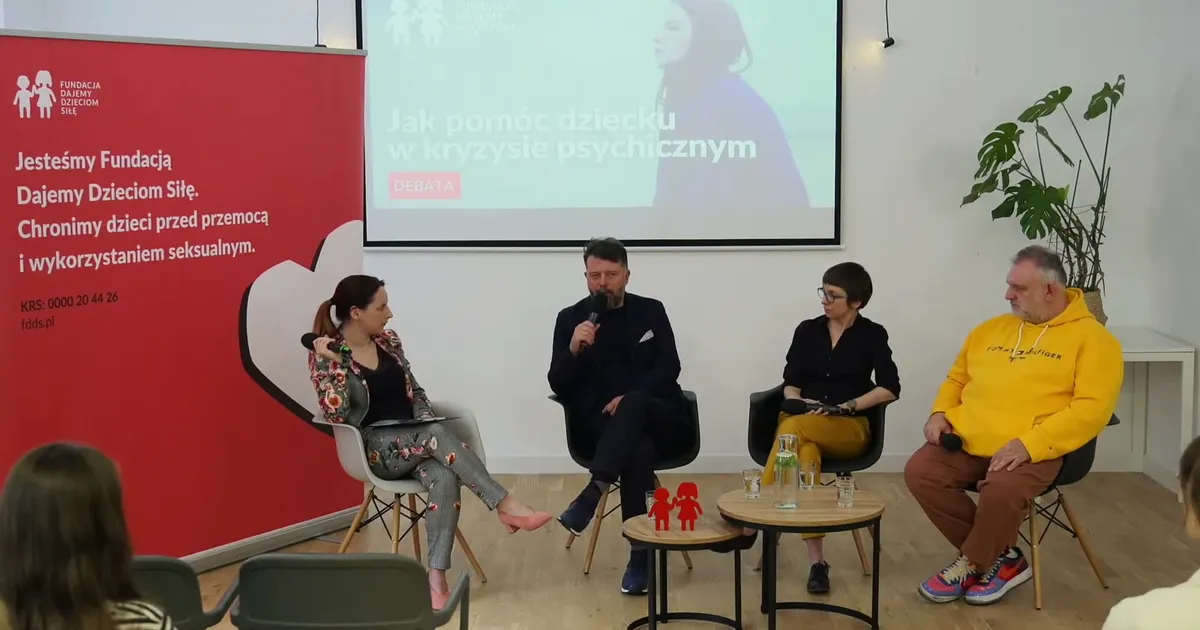
In this article you will find the main threads of the debate “How to help a child in a mental health crisis”, held by the Dajemy Dzieciom Siłę Foundation (FDDS, “Giving Children Strength”, one of Poland’s largest child protection charities): who spoke, how to recognise a mental health crisis in a child, where to look for help, what to do about self-harm and what a parent can expect from school. Plus what I said from the perspective of a dad who spent eight years as a “client of the system”.
I am coming back to this debate years later because I still get the question that came up most often back then. Several times a week. Sometimes from strangers, sometimes from someone I went to primary school with: “there is a crisis in my family, where do I look for help?”. This text is partly an answer for them.
If a child is in danger right now
In Poland, call 112. Children and teenagers can talk to the FDDS Helpline 116 111 (also chat and e-mail); adults worried about a child’s safety can call 800 100 100. Outside Poland, call your local emergency number.
In this article you will learn:
- who took part in the FDDS debate and where all the numbers come from;
- how a crisis differs from trauma and from illness;
- which red flags I noticed (too late) in my own child;
- how the care system for children works in Poland and how long the wait for a first visit is;
- what to say, and what not to say, when a child self-harms;
- what I expect from school as a parent.
What the FDDS debate was about and who took part
The debate took place on 20 April 2023 at the Warsaw headquarters of the Dajemy Dzieciom Siłę Foundation, in its Child Help Centre, with an audience in the room and a YouTube livestream where viewers asked questions in the chat. It lasted an hour and a half.
There were four of us at the table:
- Justyna Suchecka-Jadczak, a journalist at TVN24.pl, who moderated and kept an eye on the questions from the internet;
- Tomek Bilicki, an educator, psychotherapist, psychotraumatologist, crisis interventionist and civics teacher;
- Agnieszka Duszyńska, a psychologist who coordinates the team of consultants at the Helpline for Children and Young People 116 111;
- me, introduced as a social activist and a dad.
Why me? Because I have four children and two of them have been through a crisis. One fell ill at 12 and is now over 20. The youngest witnessed a suicide attempt and we are helping them out of the trauma. Over those eight years we got to know pretty much every hospital and every situation the system can put a parent through.
The background was grim. Agnieszka said that in 2022 the 116 111 helpline carried out 885 interventions to save a child’s life or health, three a day on average, and that the number has been growing since 2020, year on year and month on month. Almost 40% of conversations with children are about mental health. Since it started, the helpline has answered more than 1.4 million calls.
The full recording (in Polish) is on the foundation’s channel:

Crisis, trauma and illness: what is the difference
Tomek started with definitions, and rightly so, because parents (me too, at one point) throw these three words into one bag.
A crisis is a temporary destabilisation of the mind in response to an event. It is often a sign of health, not illness. Your dog crosses the rainbow bridge and you cannot pull yourself together for a few days? That is an adequate reaction. Tomek even said that if someone has not had a single low mood in a long time, they should go to a psychiatrist urgently, because they are probably fooling themselves quite effectively.
Trauma is an injury that stays longer, even after the symptoms are gone. Tomek stressed that most of the traumas he works with are not accidents or assaults but relational traumas, carried over from relationships with people close to us, often from early childhood.
And a mental illness or disorder is something else again, although people who are ill go through crises too.
Why does a parent need this theory? So as not to panic at every bad week, and not to play it down when the bad week lasts six months. Young people who think about death usually send signals to people they choose. And we adults have a reflex to invalidate: “don’t be sad”, “others have it worse”, “what problems can you possibly have at 15?”.
How to recognise a mental health crisis in a child: my red flags
For me this was the most important part of the debate, because here I could say something you will not find in a textbook.
I think we were attentive parents (my children, now adults, have told me so). And I did not notice that my child had fallen ill. We only saw it in hindsight, in the hospital, when it turned out that the process had been going on for about a year and a half.
Apart from a sudden crisis, it is rarely a case of everything being fine and then suddenly bad. It is more a lot of small red flags:
- The child starts studying more. Sounds paradoxical? Every mental disorder damages concentration, so a child who used to get by with little effort starts making up for it with time. Grades drop, and the child sits over the books. The parent thinks: great. Not great.
- Sleep problems. They come home from school, say they are tired, sleep 10–12 hours and are still tired. Or we know they do not sleep at night.
- A change in eating habits. Eating disorders often overlap with other problems and mask them.
- A new peer group and giving up hobbies. For us it was the move from primary to lower secondary school and quitting scouting. At the time it looked like an ordinary decision, so we missed it.
- A change in clothing. Long sleeves and thick tights on a warm day are not always a new style that comes with growing up. Sometimes they hide self-harm.
- Irritability. A parent’s reflex is to answer it with anger (“how dare you talk to me like that?”), not with closeness.
Each of these on its own means little. But two, three or five at once are, in my opinion, a signal to ask for help.
Tomek added his own list: very strong mood swings (stronger than usual for adolescence), a sudden change in behaviour when a lively child suddenly “caves in”, total isolation (“I have no friends because I am an introvert”, and introverts do have friends), losing joy in things that always made them happy, trouble with sleep and appetite. And one rule I have been repeating ever since: if you have doubts, consult someone who knows this field. And if your teenager does not want to see a specialist, go yourself.
Agnieszka pointed to younger children. Depression in a child under 10 often does not look like withdrawal and apathy but like aggression, hyperactivity and irritability.
The recording of this part starts at minute 41.
Don’t look for someone to blame
Right after my list, Tomek asked everyone in the room and in front of their screens to let go of the idea that parents are to blame for their children’s health. Can a parent contribute to something? Yes. But once the illness is there, looking for someone to blame weighs the parent down, and instead of getting better the whole family starts an examination of conscience. What did I miss, what did I not miss, could I have done more.
That last part was mine, because I think every parent who has sat in the corridor of a psychiatric hospital asks themselves that question. I did.
The parent is left alone in a child’s crisis
In my opinion this is the least described part of the whole problem.
What does it look like? There is a life-threatening situation, you hand your child over to a hospital, the door closes and you are left alone. You feel helpless, and at the same time you have to go home and hold the rest of the family together. On top of that comes the stigma attached to parents of children with mental health problems. At work nobody talks about sick children (I wrote about it in Mental Health Issues as a Taboo Topic in the Workplace). In the family, the first thought is often not “we need to support them” but “something must have been going on there, they must be monsters”.
The result? Stigma stops people asking for help, and the lack of help deepens the crisis. The circle closes.
At the debate I also talked about two extreme family attitudes that came up in workshops we once ran with young people. The first is denial, often with violence in the background: “in my day a belt was enough, this is all made up”. The second is overprotection: “go for a run, I baked your favourite cheesecake, why aren’t you happy when we look after you so well?”. The second one is just as much of a burden. I know that from my child, who once told me: “Dad, you don’t have to ask how I’m feeling three times a day”.
Justyna remarked that once is sometimes enough. She was right.
Where to get help for a child in a mental health crisis
This was the question asked most often in the chat, and it is the same question I get in messages.
In 2019 I prepared a list of almost 400 places where parents can look for support. It was published by Poland’s Patient Rights Ombudsman, with whom I worked. Before the debate I decided to update and verify it, because a list of addresses is not enough, you also need to know which centres keep the standard. The current list of organisations working for mental health is on the Ombudsman’s website (in Polish, latest version from October 2025), split by region, with addresses and phone numbers.
Agnieszka described the system the Polish Ministry of Health has been introducing since around 2020. It has three levels (officially “reference levels”, which is not a friendly phrase for a parent in crisis):
- Community mental health centres and clinics for children and young people: psychologist, psychotherapist, community therapist, no referral needed. Addresses at czp.org.pl (in Polish).
- The level with a psychiatrist.
- Hospital treatment: a day ward or a 24-hour ward.
“But you have to wait a year anyway,” someone wrote in the chat. Is that true? Not quite. I took part in the work on the reform of child and adolescent psychiatry, and the idea behind the first-level centres is that admission should be quick. The standard is 7 days (not 72 hours, as you sometimes hear). In August 2022 we asked 60 such centres: most of them met it, there were some delays, but the first visit happened quickly. The long queues are for psychiatrists.
Agnieszka added advice I find very practical: join the queue for a psychiatrist anyway. Even if you go private for one or two visits now, in a few months you will be able to continue treatment free of charge, and problems that last longer than a month usually still need therapy six months later. In an emergency there is the hospital admissions room, and Justyna reminded everyone that more and more family doctors are trained in this area.
Parents who do not know where to start can call 800 100 100.
How many people does it take to help a teenager in crisis?
We asked ourselves this question while preparing for an earlier debate, and the answer came to about 20 people. Who are they? The school, the family, therapists, doctors, the mental health centre. Today these people often do not talk to each other: the centre does not pass information to the school, and the school does not know what is happening in treatment. And the support should cover the whole family, not just the child.
What to do when a child self-harms
Justyna said that questions about self-harm came in more than any others. For example: where do I look for help when my twelve-year-old self-harms, young people never used to do this, is it some kind of trend?
Tomek replied that self-harm serves an important function for young people, which is why the first thing not to do is say “come on, it doesn’t do anything for you”. Do not threaten, do not punish, do not shout. Try to understand what function it serves and whether something else could take it over. And find the strength to ask a very difficult question: “have you thought about doing something more to yourself?”. That is a question about suicidal thoughts, and according to Tomek a teacher, school counsellor or parent can ask it before the child ever reaches a specialist.
Agnieszka explained how children describe it on the helpline: as turning mental pain into physical pain, which brings brief relief. What is behind it? Suffering nobody has named yet, sometimes a secret the child carries alone. That is why the help of a psychologist or psychotherapist is needed, and very often support for the parent as well.
Why children don’t tell their parents about their problems
Agnieszka told us what she hears on 116 111. Children talk about two things. The first is how adults react: “you’ll grow out of it”, “boys don’t cry”, “what are you making up”. The second hit me at the time. Why do children keep quiet? Because they do not want to worry their parents. Dad lost his job, grandma died, mum is grieving, so the parents have “real problems” and I am not going to add to them.
The consultants then explain to the child that the roles have been reversed. It is the parent who has the means and the competence to look after the child, and only the parent can take them to a psychologist.
Some children call not about themselves but about a friend. Tomek quoted a UNICEF survey according to which more than half of young people talk to a peer when they feel bad, and only 30% to an adult. That is why he called for teaching peer crisis intervention in schools: loyalty to a friend does not mean keeping every secret, it means acting when their life is in danger. With the right to your own boundaries, because a teenager who helps can also not pick up the phone.
What I expect from school as a parent
Justyna asked me this question, and I answered with one word: availability.
My own story happens to be a positive one. My child knew about their crisis earlier than we did and did not tell us. Instead, while I was abroad on a three-day business trip, my then eleven-year-old logged into the school admissions system and changed the chosen lower secondary school on their own. To a public school in Warsaw’s Powiśle district that supports students with mental health problems. When I came back I heard: “Dad, there’s something, I know you might be angry, but I changed schools”.
The crisis started in July and on 1 September my child went to hospital instead of that school. They wanted so badly to make it that they were discharged, and after seven days they asked to go back to hospital themselves, admitting they had been pretending to feel better. The school behaved brilliantly: we stayed in touch, they kept the place, the class sent a Christmas card, and from the second semester my child went back to that school. I tell the whole story from minute 61 of the recording.
So I don’t want to say it is always bad. But I also know what it looks like from the other side, because a relative of mine is a school psychologist in Warsaw. A school psychologist rarely has one school of 350 students. Usually they have four. That makes about 1,400 children. How much time is left for each one? Roughly two minutes a month. I have heard that school psychologists are unwilling because they “chose the wrong career”, when it is simply a lack of availability.
Agnieszka added something that costs very little: the atmosphere around the psychologist. In one school you hear “seeing the psychologist is OK”, in another “do that again and you’re going to the counsellor”. And Tomek showed that a teacher can start a lesson by asking which dog from the photos on the screen a student identifies with today, or how many “bars of battery” they have, instead of taking the register.
What to read, what to watch and who not to listen to
A professor from the Maria Grzegorzewska University (Warsaw’s university of special education) asked from the audience whether parents should read developmental psychology. My answer: yes, and every parent of a sick child ends up “getting a PhD” in the subject anyway. Sometimes too much of one, because then they come to the doctor and tell them how to treat.
What helped me a lot were good books from Polish publishers, above all the two-part “Depresja nastolatków” (“Teenage Depression”) by Konrad Ambroziak, Artur Kołakowski and Klaudia Siwek (Gdańskie Wydawnictwo Psychologiczne). The authors are a child and adolescent psychiatrist and two cognitive behavioural psychotherapists, and we reviewed the books back in the days of “Porcelanowe Aniołki”, my blog about teenage depression. Which part is for what? Both are in Polish:
- “Depresja nastolatków. Jak ją rozpoznać, zrozumieć i pokonać” (“Teenage Depression: How to Recognise, Understand and Overcome It”) is the compendium: what depression in young people is, where it comes from and how it is treated;
- “Nastolatek a depresja. Praktyczny poradnik dla rodziców i młodzieży” (“The Teenager and Depression: A Practical Guide for Parents and Young People”, in a newer edition titled “Depresja nastolatków. Praktyczne wskazówki i skuteczne strategie wspierające leczenie”) is the workbook, with separate parts for parents and for teenagers: how to accept the child’s illness, how to deal with guilt, what supports treatment and what gets in its way, how to react in a crisis.
The books also contain data on how often depression comes back depending on the age at which it first appeared. Tomek mentioned it at the debate.
My top 3 from the debate:
- materials from the Dajemy Dzieciom Siłę Foundation, because they are always verified (the edukacja.fdds.pl platform in Polish, which Agnieszka recommended);
- the “Młode Głowy” (“Young Minds”) report, released three days before the debate;
- common sense about “medfluencers” who build reach on this topic or sell courses.
Tomek added something that stuck with me: if you have two hours and want to spend them on a book about developmental psychology, read for one hour and spend the other playing Fortnite with your child.
What stayed with me after the debate
At debates on children’s mental health I am in an odd in-between place. When I go to the ministry, I am an “expert by experience”. When I talk to professionals, I am simply a parent who went through his children’s crises. That day the “in-between” was probably the most useful thing, because Tomek and Agnieszka said what the evidence says, and I could add what it looks like from the kitchen, from the hospital corridor and from the school admissions system.
You can read more about what I do in this area on my social activities page and in the post about working with the Dajemy Dzieciom Siłę Foundation.
And if you are a parent in Poland who has just come back from the hospital admissions room and does not know what to do next: 800 100 100. You don’t need to have your question ready.
FAQ — a child's mental health crisis
Maybe we can do something together?
If you like what I write, maybe I can write something for you?